Components of a knife
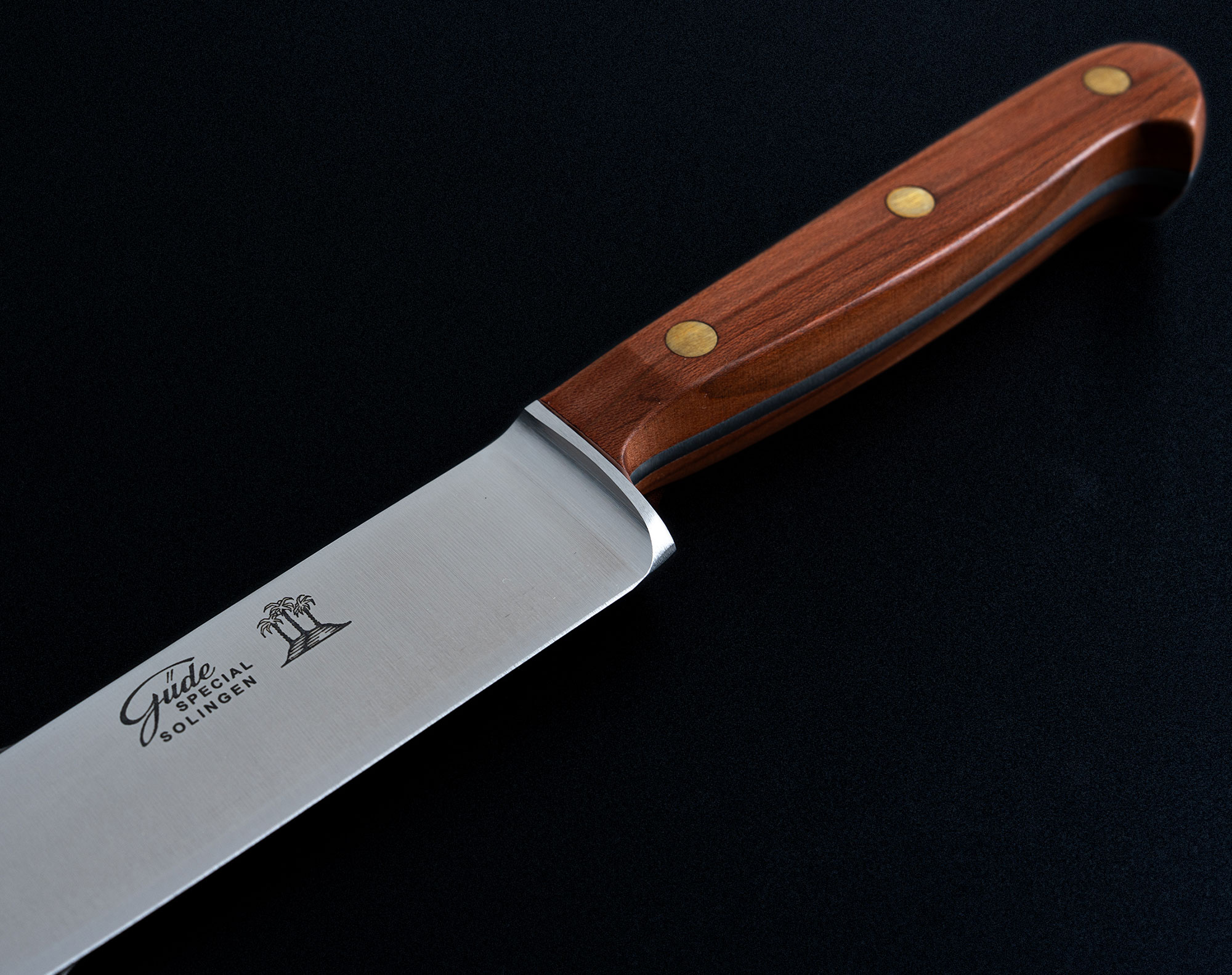
The blade material of knives has to meet a wide range of requirements, some of which are contradictory. It is therefore necessary to achieve an optimum between the various requirements. A knife steel should be hard, but not too hard, otherwise it would break. But it should also not be too soft, otherwise the knife would become dull too quickly due to wear. Therefore, the knives from GÜDE are made of a chrome-molybdenum-vanadium knife steel, which has an optimal hardness of about 57-58 HRc (Rockwell).
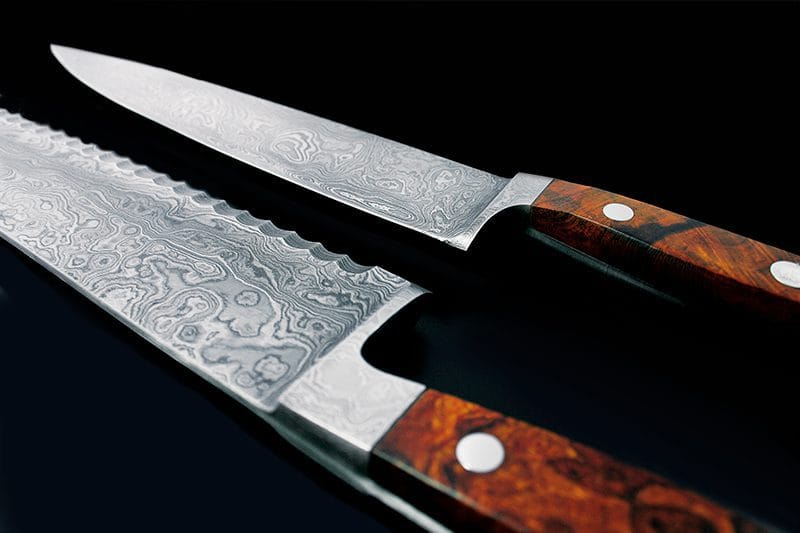
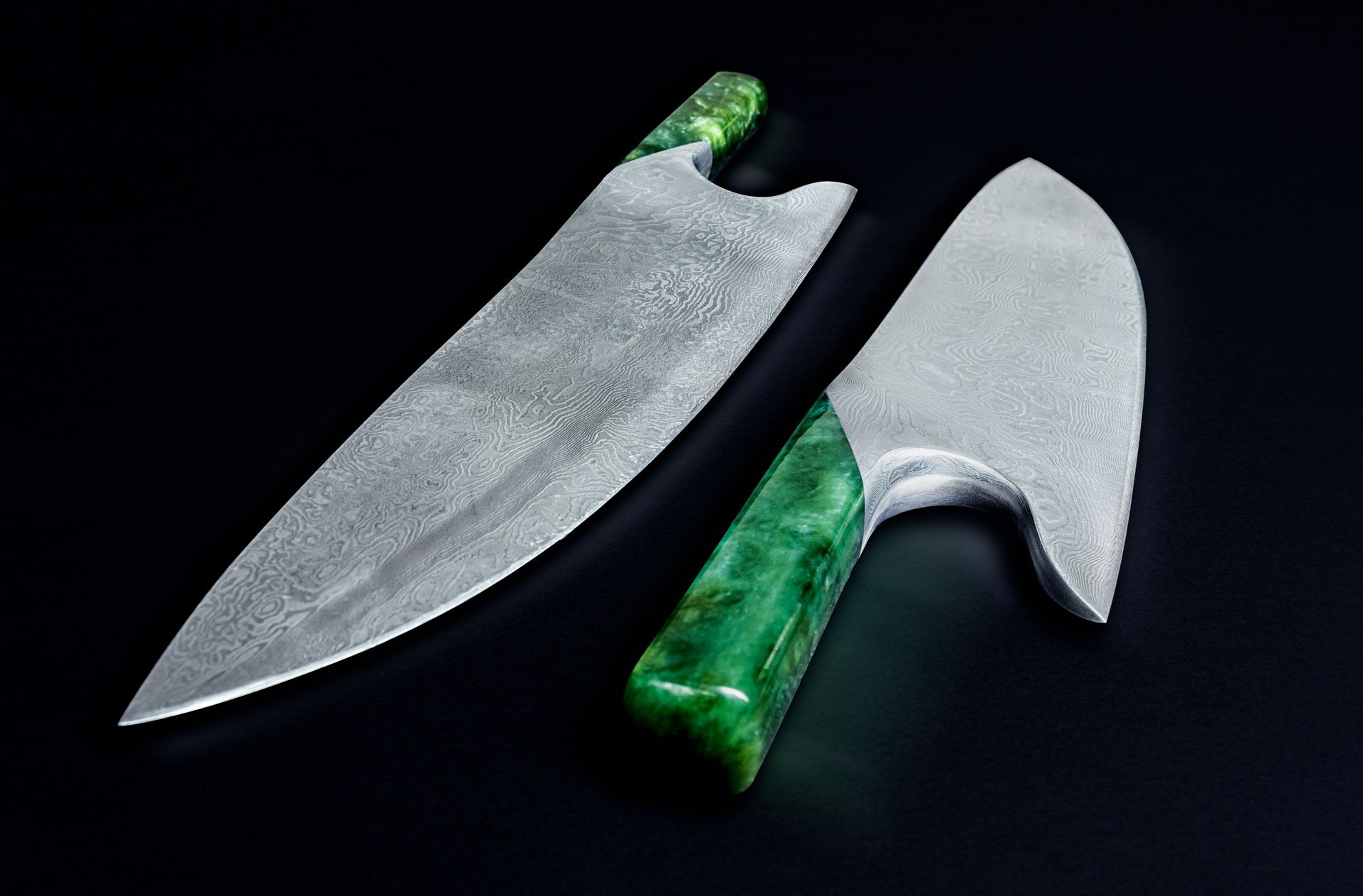
Exceptions are knives made of carbon or damascus steel. Carbon steel contains more carbon, thus can have higher hardness values, but is more susceptible to rust. Damascus steel consists of different layers of a hard and a softer steel and thus combines the advantages, but also the disadvantages, because it is not rustproof.
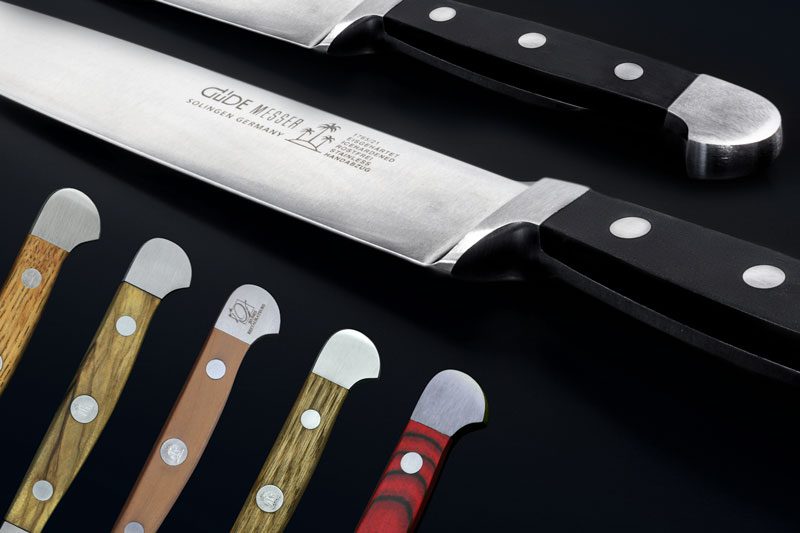
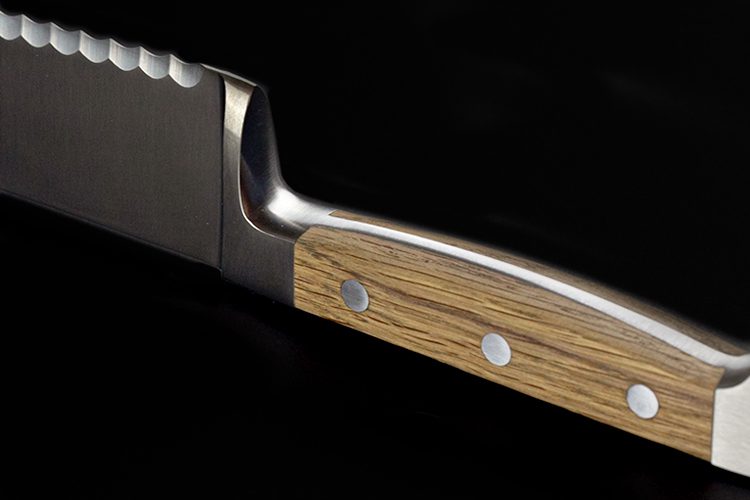
Wood is a natural material. Its colour and grain make a knife a real eye-catcher. But wood also shows its pleasant side when gripping a knife, as it feels warm and soft to the touch. However, handles made of wood are not dishwasher-safe, unlike handles made of plastic. Plastic handles from GÜDE are made of Hostaform and meet the requirements of the catering industry. They are easy to clean and dishwasher safe.
Drop forging ensures high material strength even under dynamic stresses. In drop forging, the entire forging blank is heated and deformed.
In contrast, in upsetting forging only a small part of the strip steel, usually the middle part, is heated and then deformed. This method is mostly used for reasons of production economy; the achievable mould material is very limited.
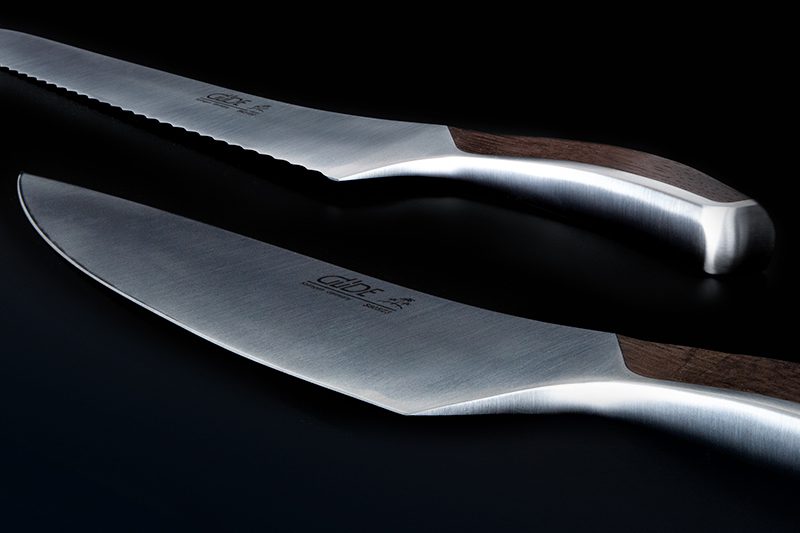
In drop forging, the shape is free from the tip of the blade to the end of the handle. A design language like that of SYNCHROS or THE KNIFE. is only possible in the drop forging process. That is why GÜDE remains true to this proven technology.
Even a hard steel, such as GÜDE knife steel, can be very flexible when ground very thin. A flexible blade is particularly suitable for filleting fish by moving the blade back and forth between the skin and the fillet with a slight bend.
A rigid blade is torsionally stiff and thus guarantees a more precise guiding of the knife and thus a more precise cut.
The front part of the SYNCHROS carving knife is ground thin so that the blade is flexible in this area. This makes the SYNCHROS carving knife equally suitable for filleting fish.
Cutting is "physically" the driving of a wedge through a material to be cut. The sharper the angle of the wedge, i.e. the bevel angle, the better this works. Bevel is the term used by knife makers to describe the cutting edge, i.e. the sharpened part of a knife. A sharp bevel angle makes a knife sharper than a blunt bevel angle.
However, if the bevel angle is too sharp, the bevel can break. That is why GÜDE knives have GÜDE optimal bevel angle of approx. 33 degrees. This angle guarantees both sharpness and stability.
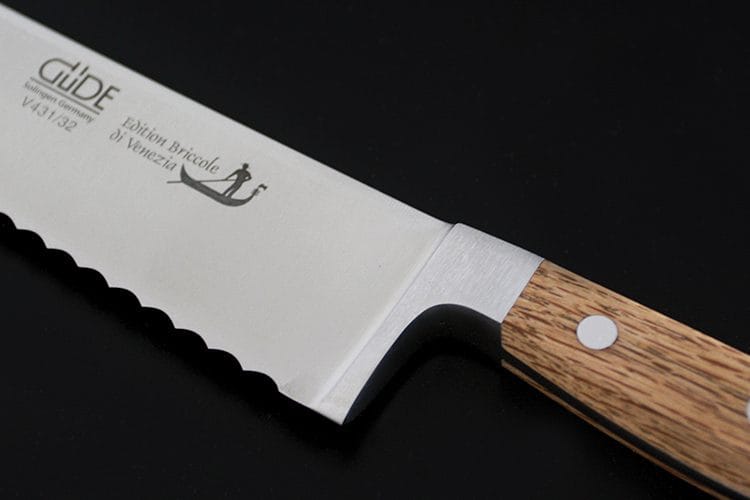
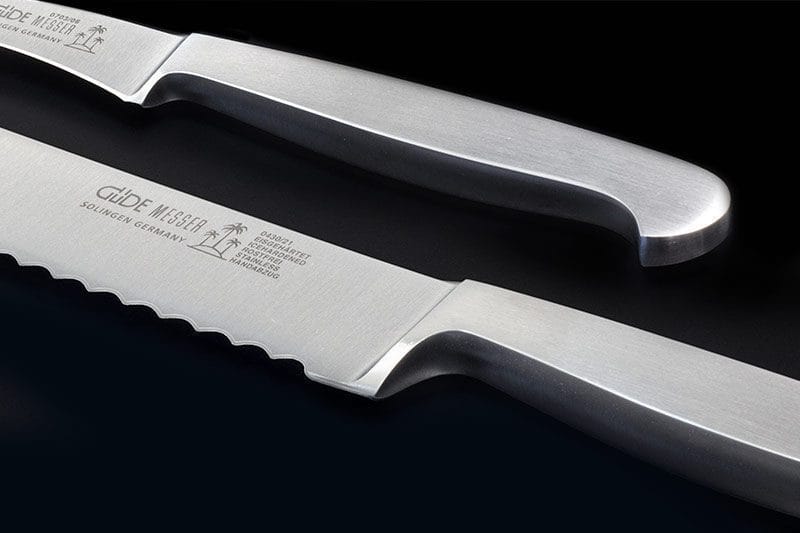
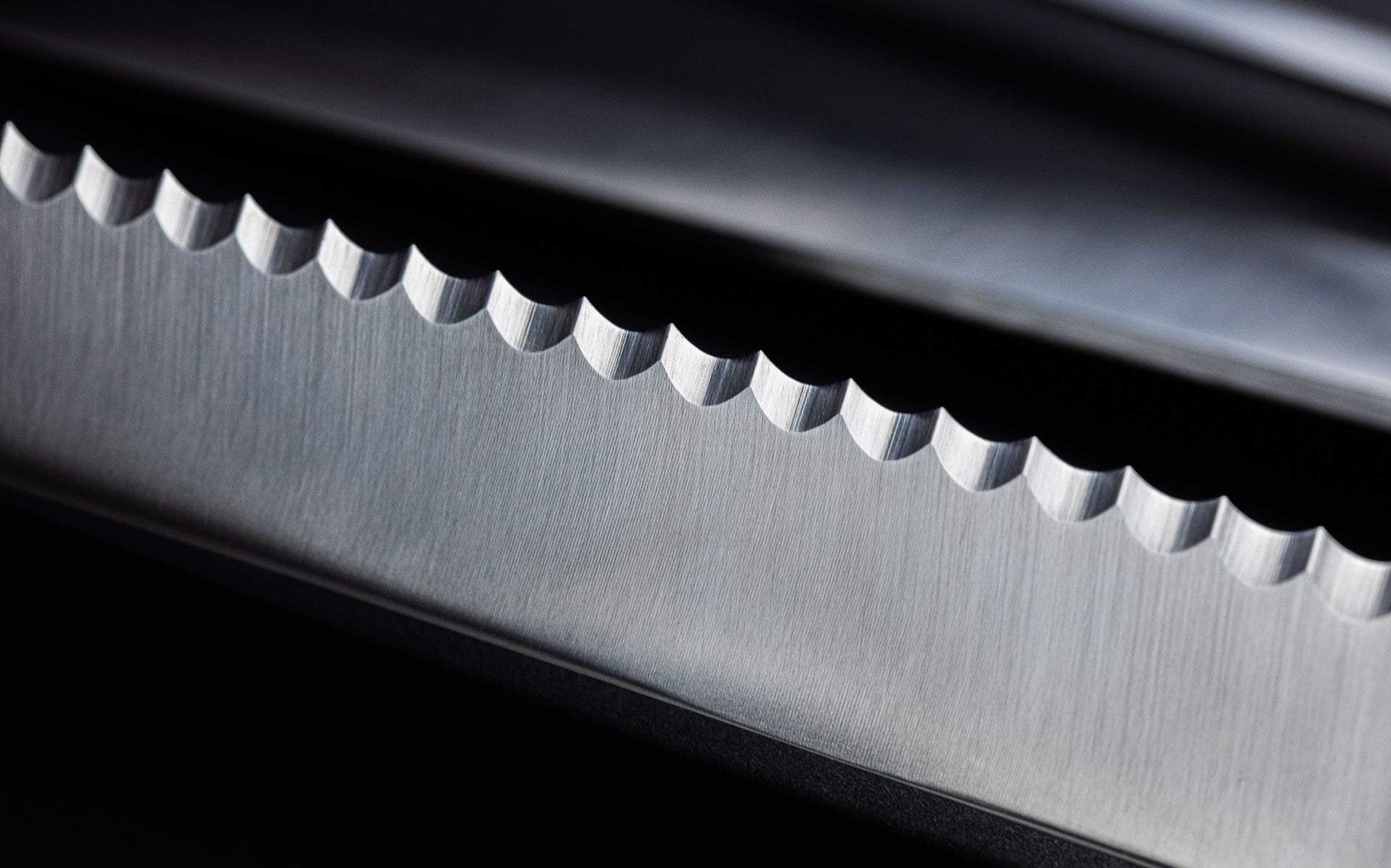
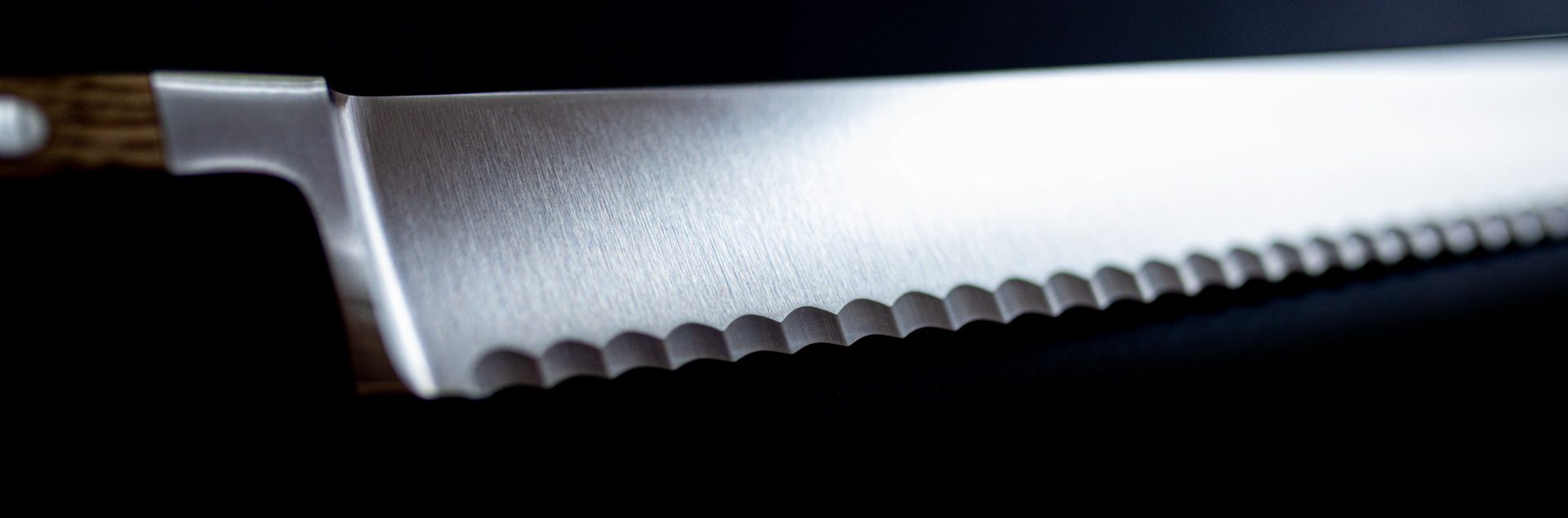
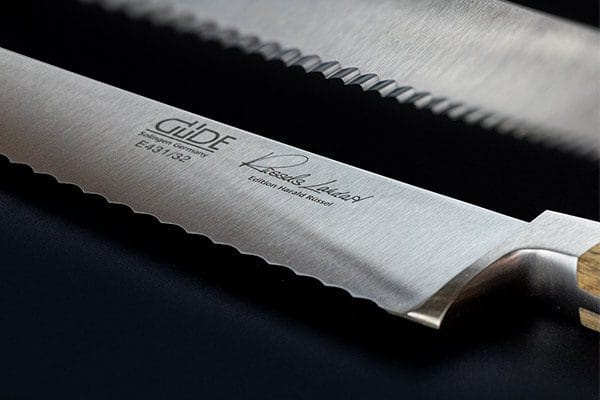
As early as the end of the 1930s, people at GÜDE were thinking about how best to design the teeth of a bread "saw". The result was the "GÜDE serrated edge", whose inventor is Franz Güde .
The special "GÜDE serration" has more aggressive teeth than conventional serrations. Both cutting ability and edge retention are increased by this special grind. And so the Franz Güde bread knife glides through even the hardest crusts.
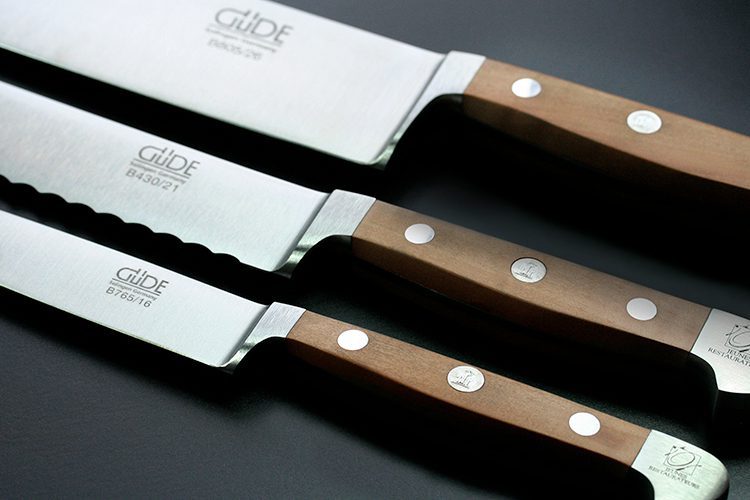
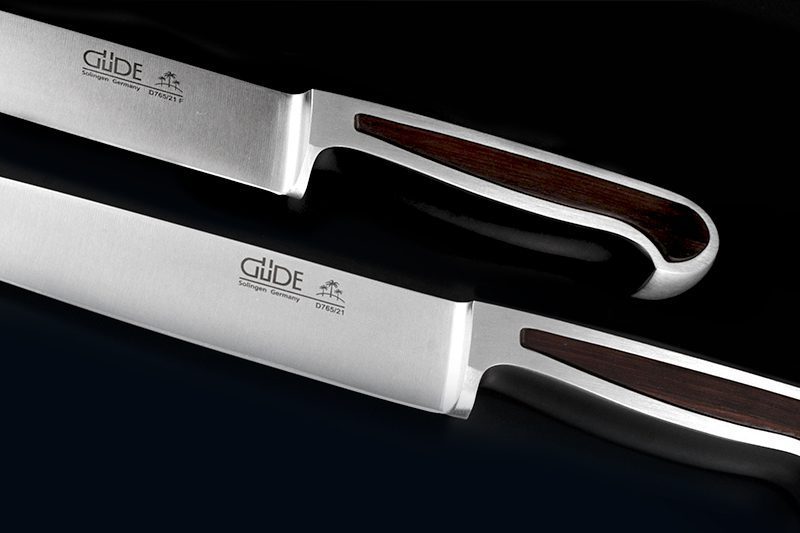
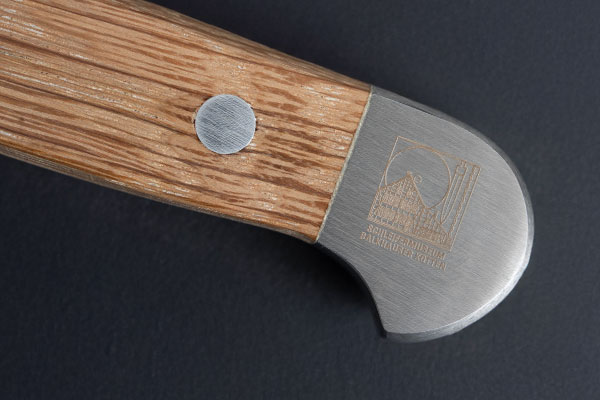
The bolster is the thickening of the blade steel. The (front) bolster between the handle and the blade serves both as finger protection and balance weight.
An unmistakable feature of many series from GÜDE is the so-called double bolster. The second bolster at the end of the handle gives the knives a better balance. This guarantees the user pleasant and fatigue-free work.
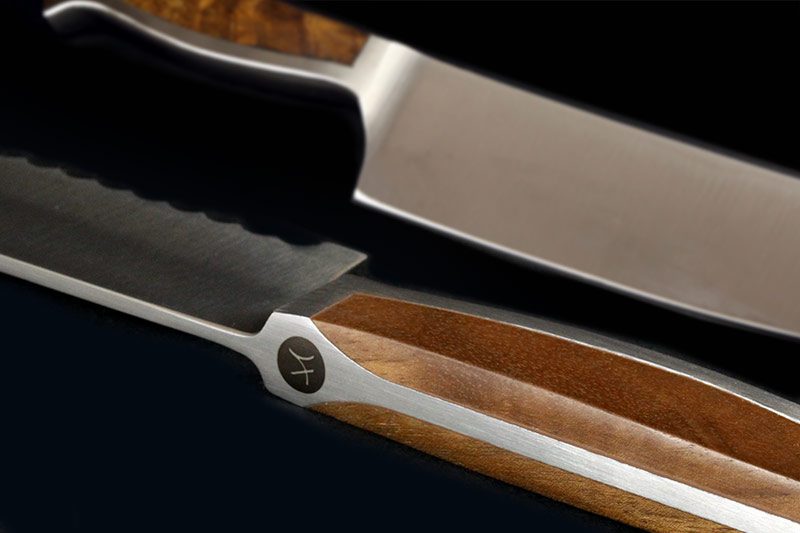
THE KNIFE . and the knives from the SYNCHROS series deliberately do without the bolster. The seamless transition from handle to blade creates a completely new haptic and functional experience.
The tang is the part of the steel to which the handle of a knife is attached. If the tang goes from the blade to the end of the handle, it is called a full tang. The tang, as the name suggests, is stuck in the handle so that it is not visible.
The full tang, on the other hand, can be seen between the handle scales on knives from the Alpha series. On series such as SYNCHROS or Caminada the full tang is formed as a cross tang at the lower end of the handle.
The knives from GÜDE all have a full tang, as this provides a better balance of the weight. An exception is THE KNIFE. Since this knife is only used in the so-called overhand grip, the balance is automatically achieved by the grip position, so that the centre of gravity is inside the hand.
The "standard grip" refers to the position of the hand exactly around the handle of a knife, e.g., Alpha the front and rear bolsters in the Alpha series.
To achieve better power transmission and more precise control, many professional and amateur chefs grip the knife further forward, so far forward that their thumb and index finger grip the blade on the left and right. This grip is called an "overhand grip."
THE KNIFE. is designed so that you automatically grip it in an "overhand grip." The SYNCHROS series SYNCHROS the user to choose how they want to grip the knife.
Our knife collections
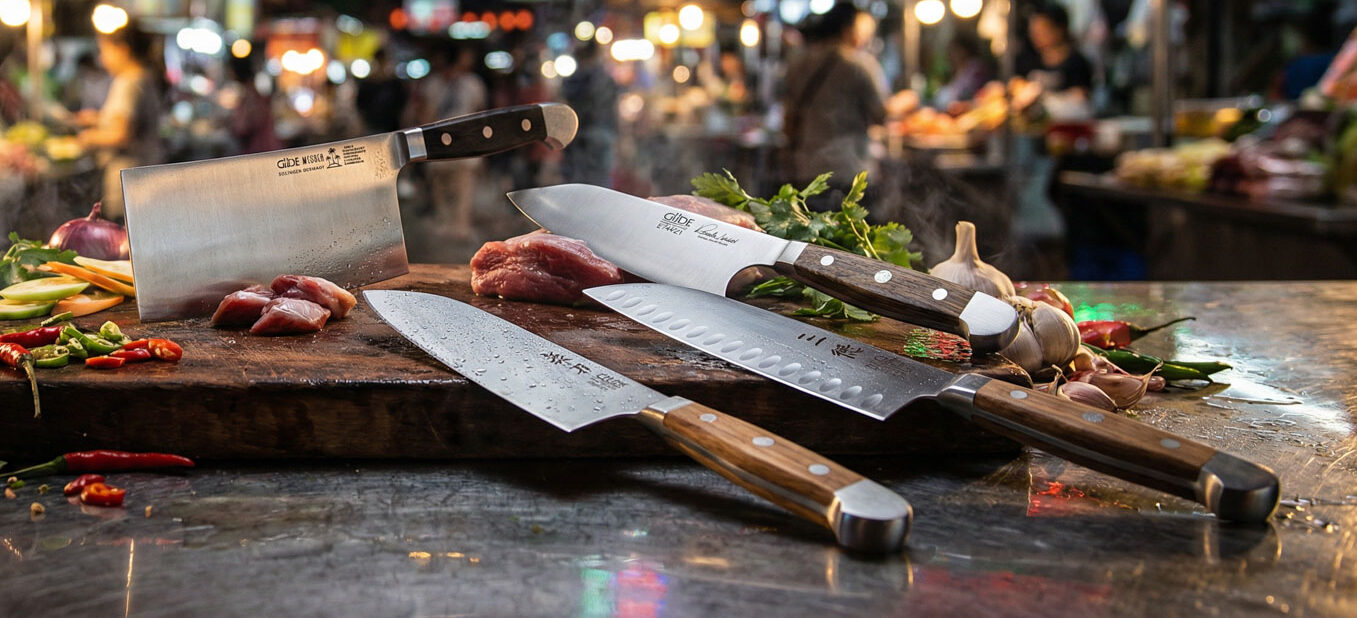
We value individuality—especially when it comes to developing and refining our knife collections. This is reflected in every single blade that leaves our workshop, in the selection of particularly beautiful and tactile handle materials, and in a unique ergonomic design that enables and celebrates fluid, fast, and precise work.

Gourmet x Güde
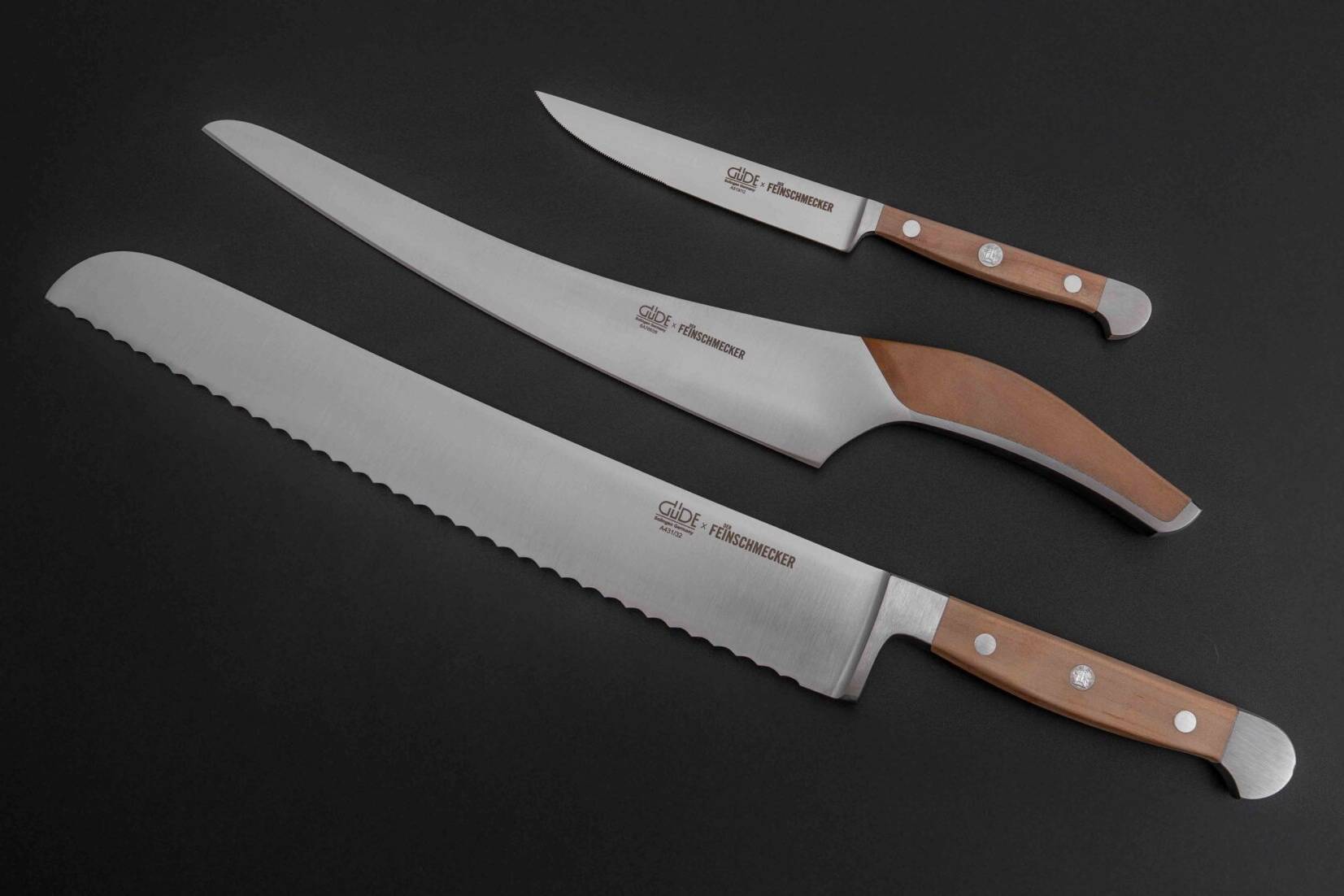
The exclusive "Feinschmecker" edition combines genuine craftsmanship from Solingen the high standards of Germany's leading gourmet magazine.
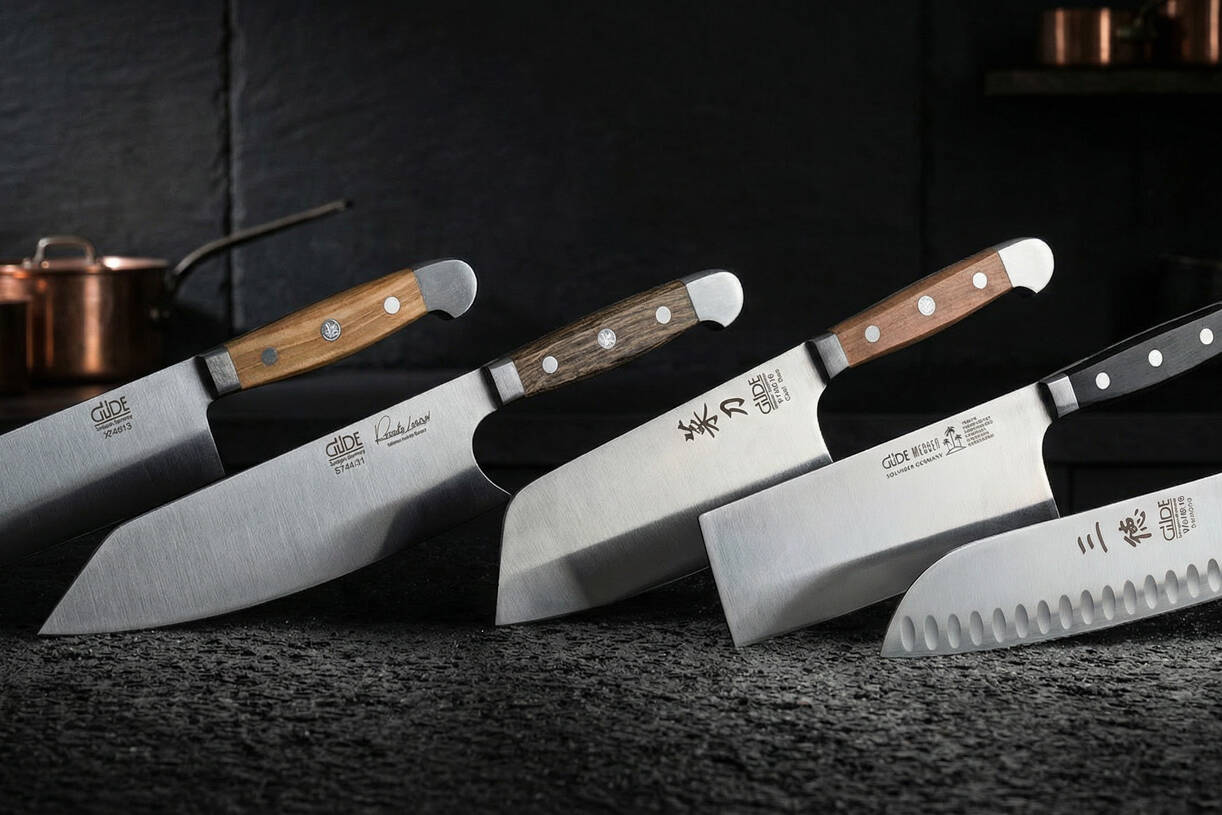
Discover Messer Icons
THE KNIFE.
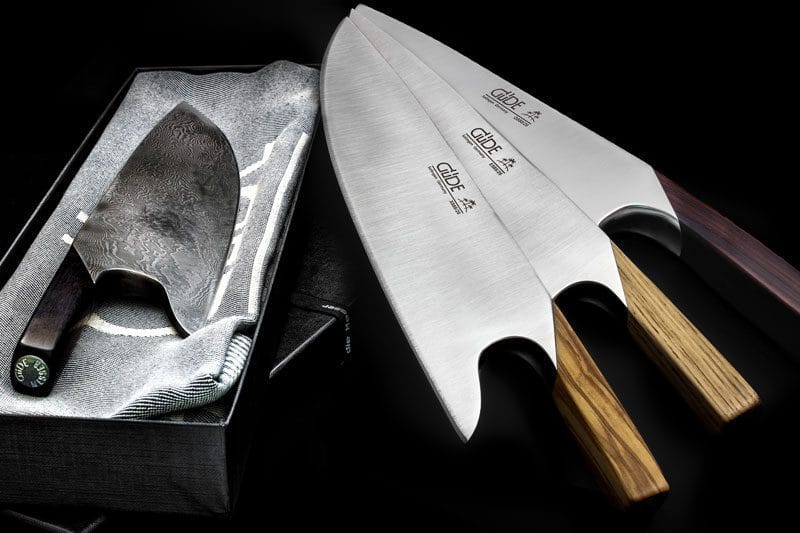
Our THE KNIFE. lives up to its name: we conceived, developed, and forged this all-purpose knife with a particular focus on perfect ergonomics. Its unique shape and balance allow the hand to naturally wrap around the blade while cutting, making THE KNIFE. feel like a natural extension of the hand.
Bread knife
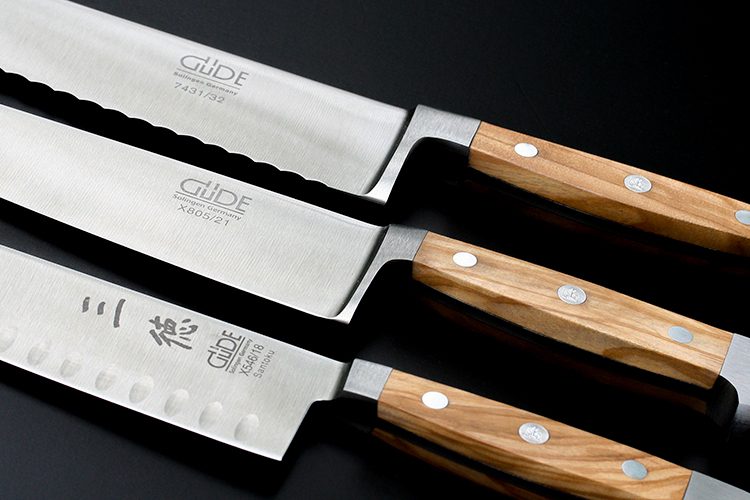
Güde in 1941 by master craftsman Franz Güde , the distinctiveGÜDE on our bread knives continues to delight bakers and bread lovers around the world today. The pointed serrations of the unyielding, sharply ground chrome-vanadium-molybdenum steel ensure that loaves, baguettes, and rolls are sawed rather than crushed, and that cabbage, melons, and crispy-crusted roasts can be cut with ease like never before. Simple yet elegant handles made from various high-quality materials further contribute to the legend of our knives.
Utility knife
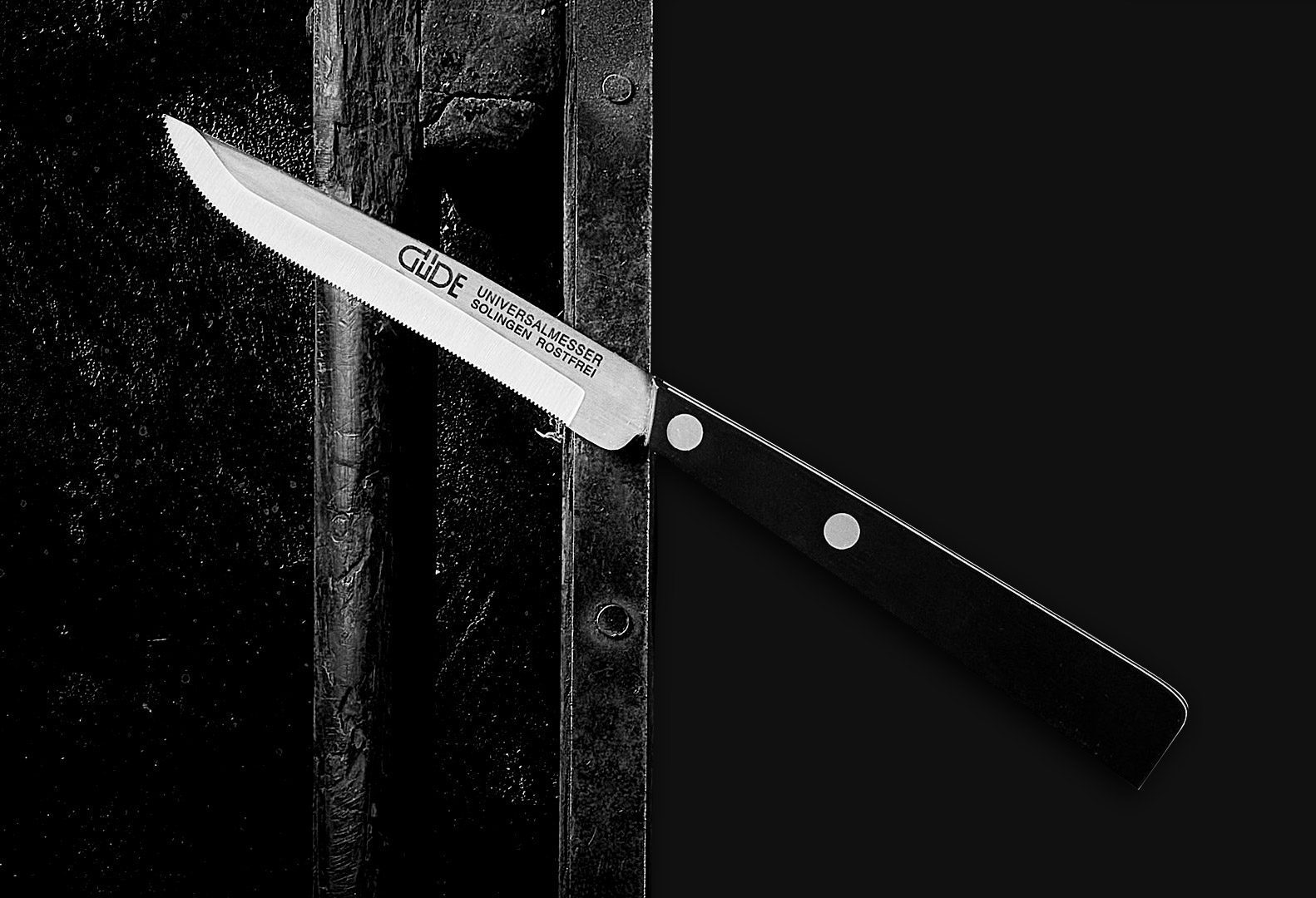
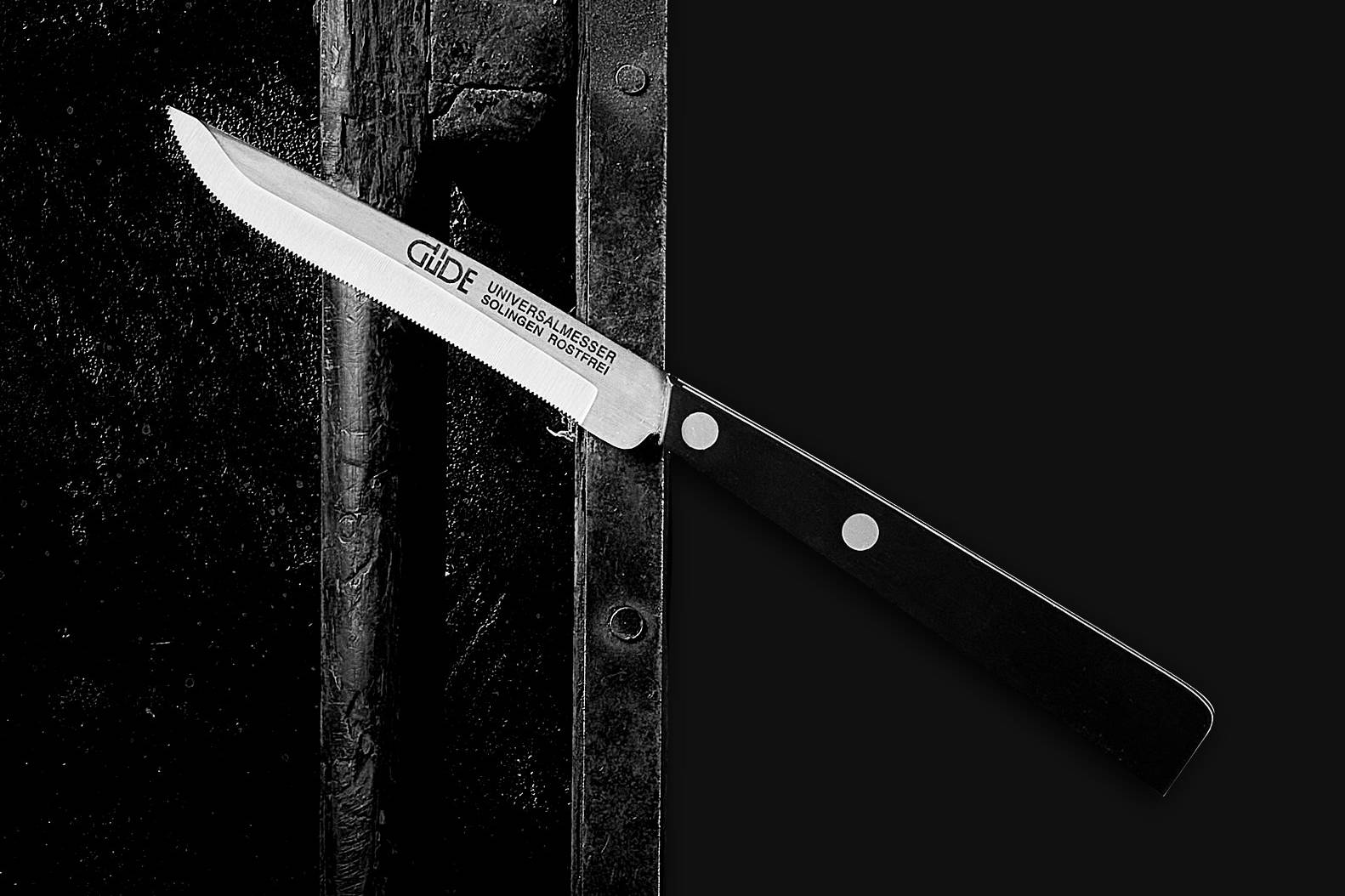
Our compact all-rounder is easy to handle and highly effective—not just for precise work with smaller items. Its fine serrations and double-sided hollow grind make our utility knife the perfect tool for peeling, slicing, and cutting vegetables, meat, fruit, and more.