


Güde chef's knife from Solingen: Precision, tradition and diversity – for every task the perfect tool
For over 100 years, Güde has been manufacturing kitchen knives Güde heart of Solingen that combine craftsmanship and the latest technology. Anyone who is passionate about cooking knows that the right knife is the heart of every kitchen. But not all knives are the same—each blade shape has its own strengths and history.
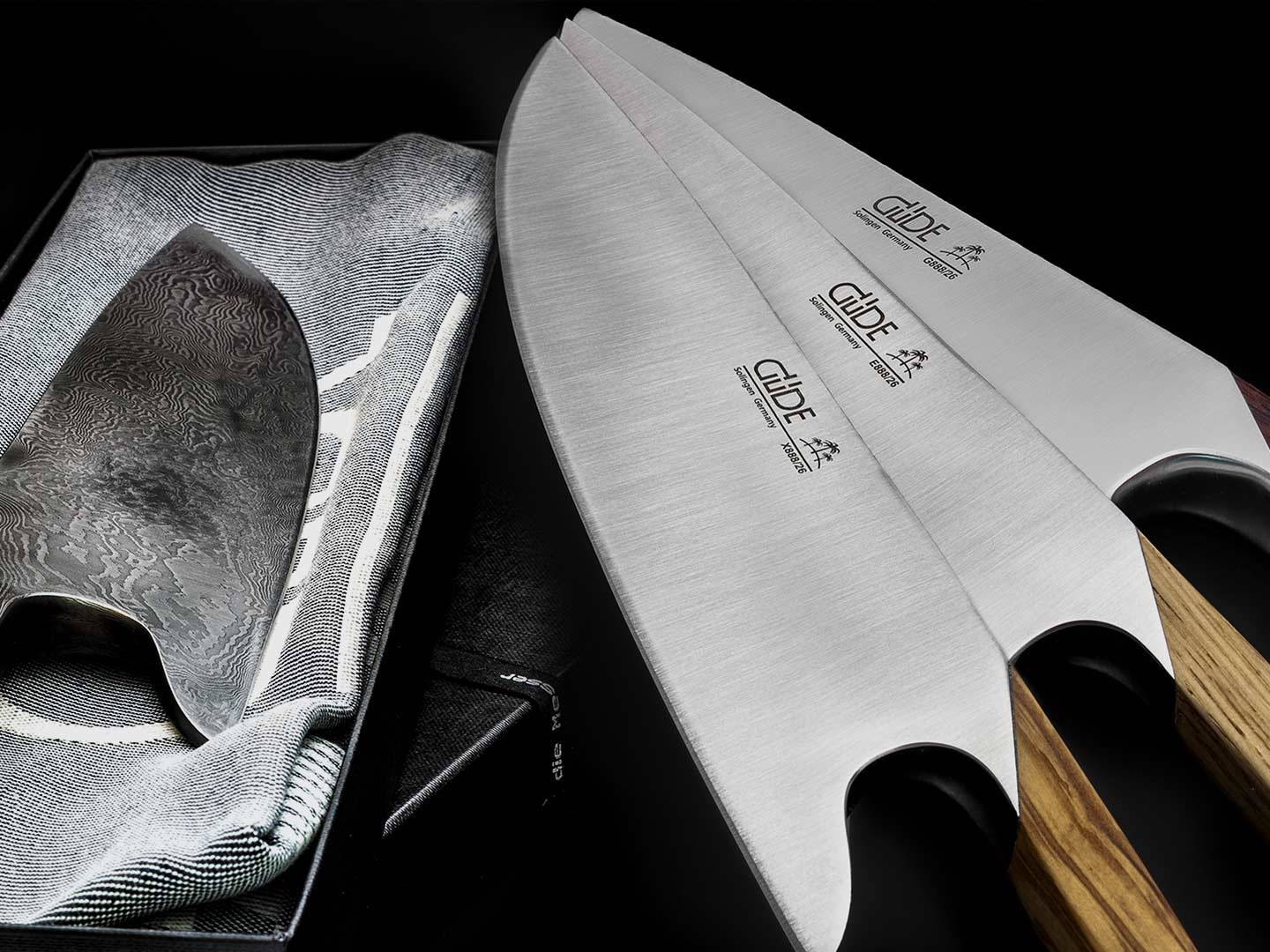
THE KNIFE.
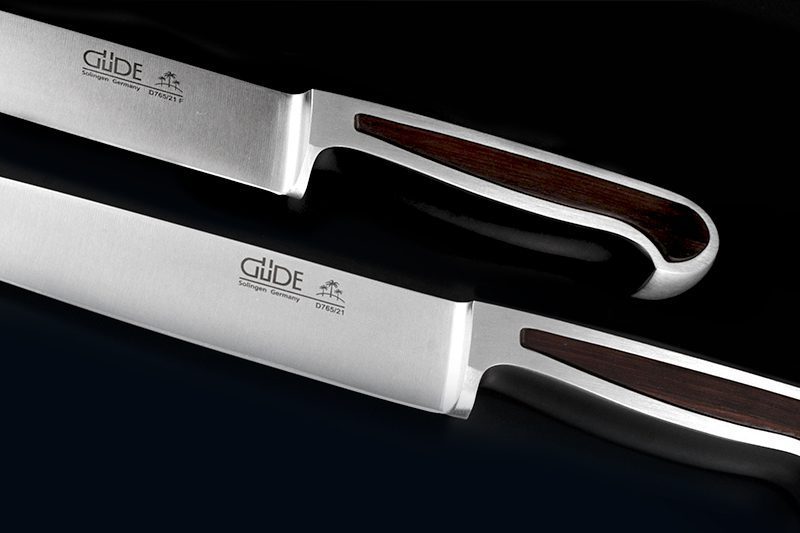
The uncompromising statement knife: modern design, highest manufacturing quality, and a blade that redefines all standards. For those who refuse to compromise.
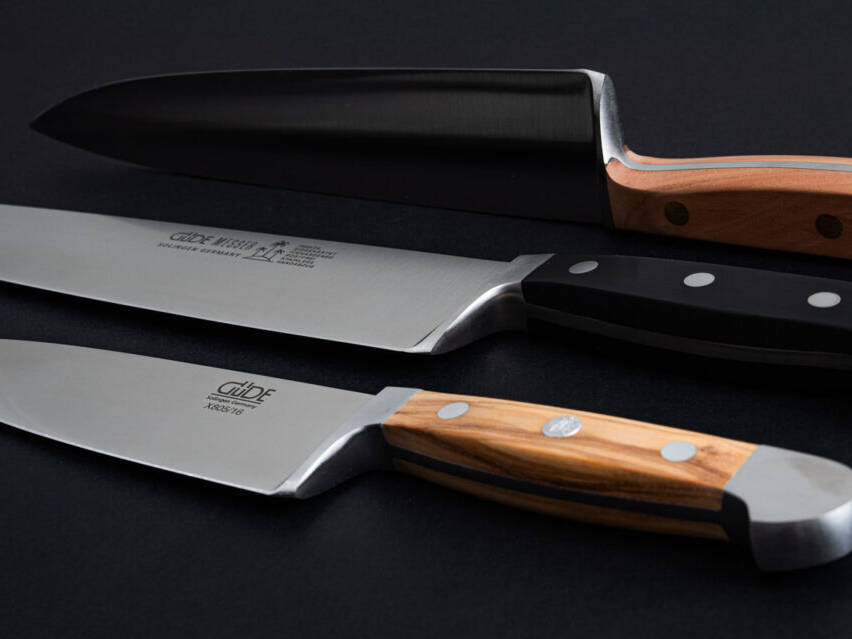
Chef's knife classic
The classic chef's knife is the all-rounder in every kitchen. With its balanced shape, it effortlessly handles any cutting task—from chopping fresh herbs to filleting meat and...
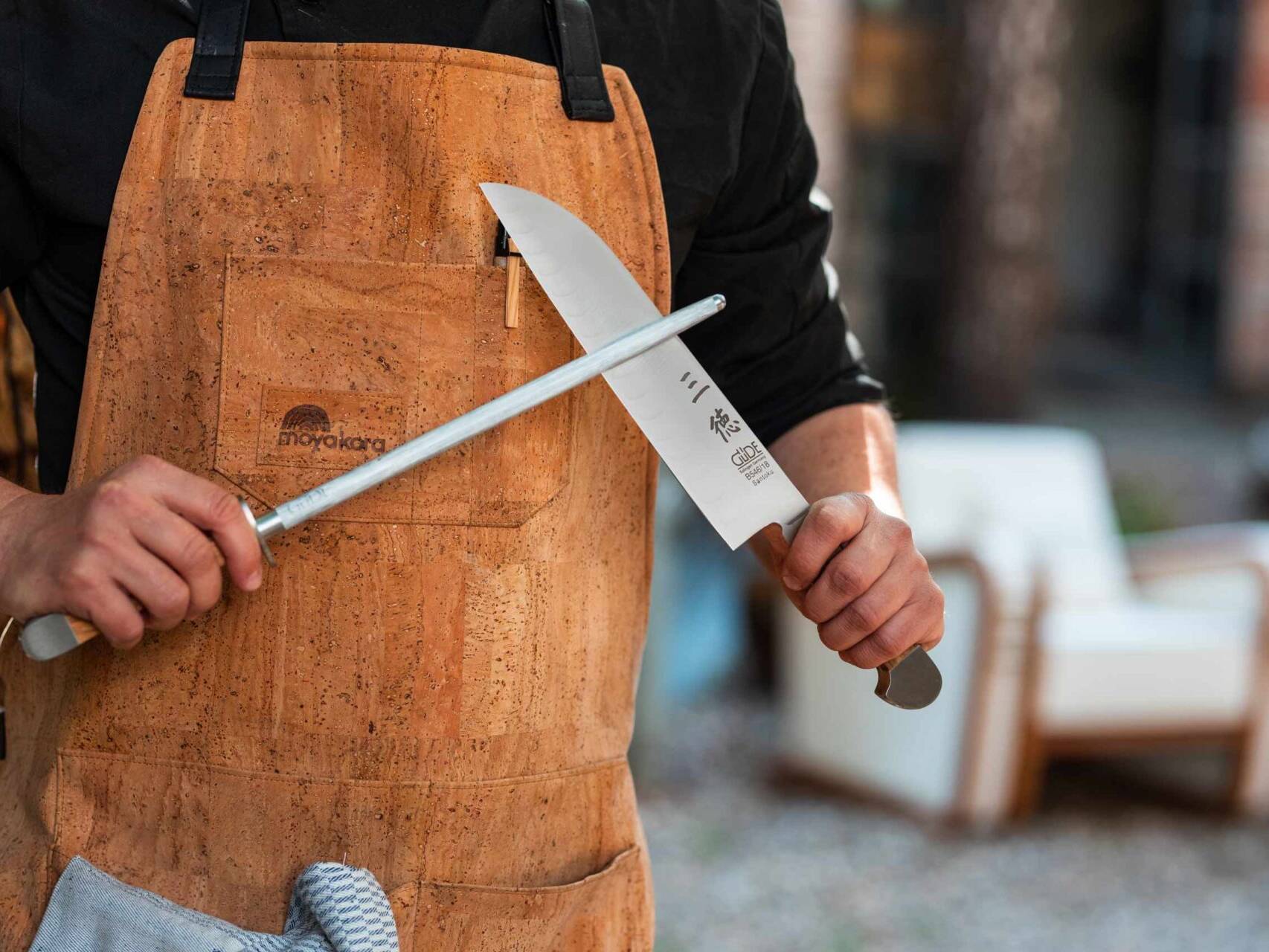
Chef's knife Santoku
This Japanese classic is known for its versatility and fine cuts. Whether cutting fish, meat, or vegetables, the Santoku knife impresses with its precision and comfort.
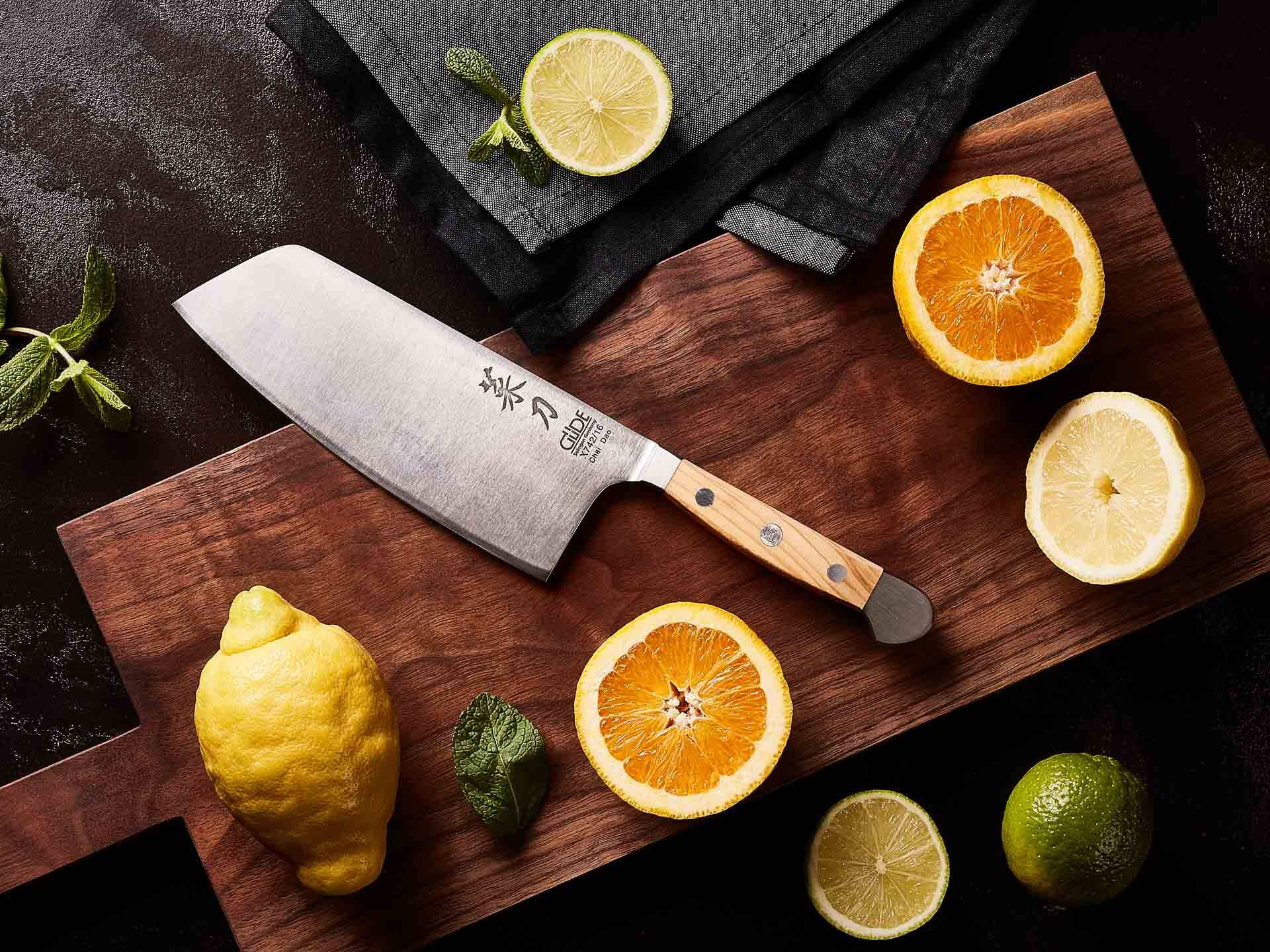
Chef's knife Chai Dao
Asian elegance meets perfect craftsmanship: the Chai Dao is ideal for precise cutting and fine chopping of vegetables, herbs, and more.
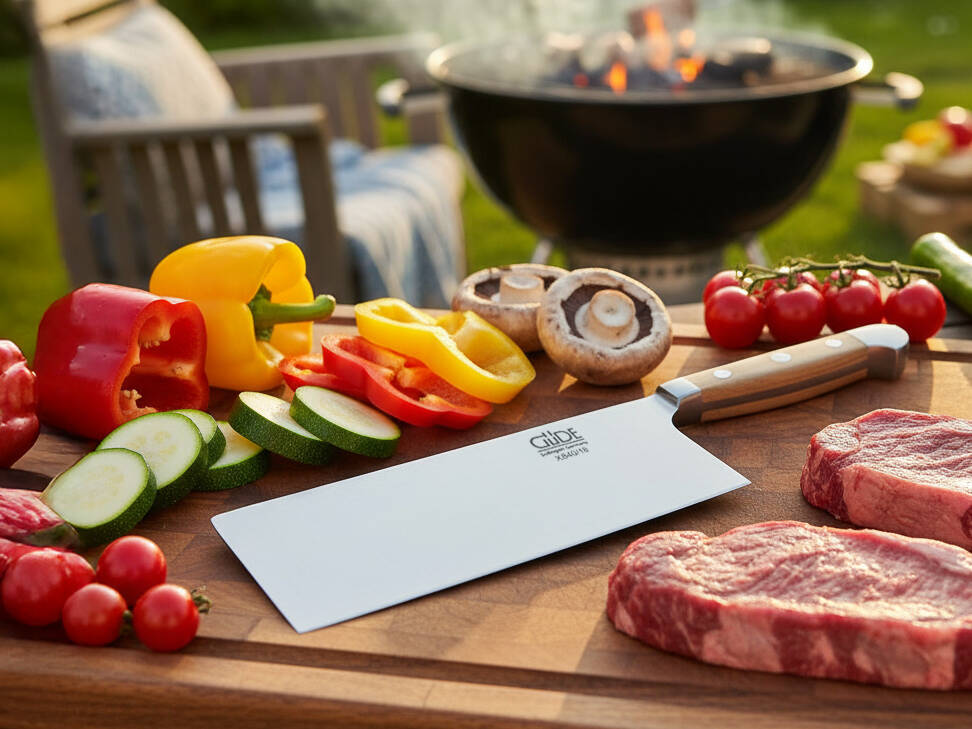
Chinese Chef's Knife
Discover the China chef's knife from Güde hand-forged in Solingen, with a wide, extremely sharp blade and elegant handle. The perfect knife for quick cutting, chopping, and preparing food...

Chef's knife Kappa
Price range: € 146.00 to € 192.00Select version This product has several variants. The options can be selected on the product page

Chef's knife Mikarta
188,00 €
Damascus chef's knife
1.762,00 €
Chef's knife Briccole
222,00 €
Chef's knife Delta
Price range: € 163.00 to € 197.00Select version This product has several variants. The options can be selected on the product page

Pear chef's knife
Price range: € 164.00 to € 214.00Select version This product has several variants. The options can be selected on the product page

Chef's knife Franz Güde
149,00 €
Chef's knife olive
Price range: € 150.00 to € 194.00Select version This product has several variants. The options can be selected on the product page

Chef's knife walnut
Price range: € 164.00 to € 214.00Select version This product has several variants. The options can be selected on the product page

Alpha chef's knife
Price range: € 120.00 to € 168.00Select version This product has several variants. The options can be selected on the product page

Chef's knife barrel oak
Price range: € 164.00 to € 214.00Select version This product has several variants. The options can be selected on the product page

Chef's knife Synchros Olive
278,00 €
Chef's knife Synchros smoked oak
278,00 €
Chef's knife Karl Güde
Price range: € 157.00 to € 196.00Select version This product has several variants. The options can be selected on the product page

Chef's knife Balkhauser Kotten
188,00 €
THE KNIFE. DAMASCUS STEEL SMOKED OAK
2.969,00 €
THE KNIFE. Barrel oak
395,00 €
THE KNIFE. SMOKING AREAS
395,00 €
THE KNIFE. Olive
395,00 €

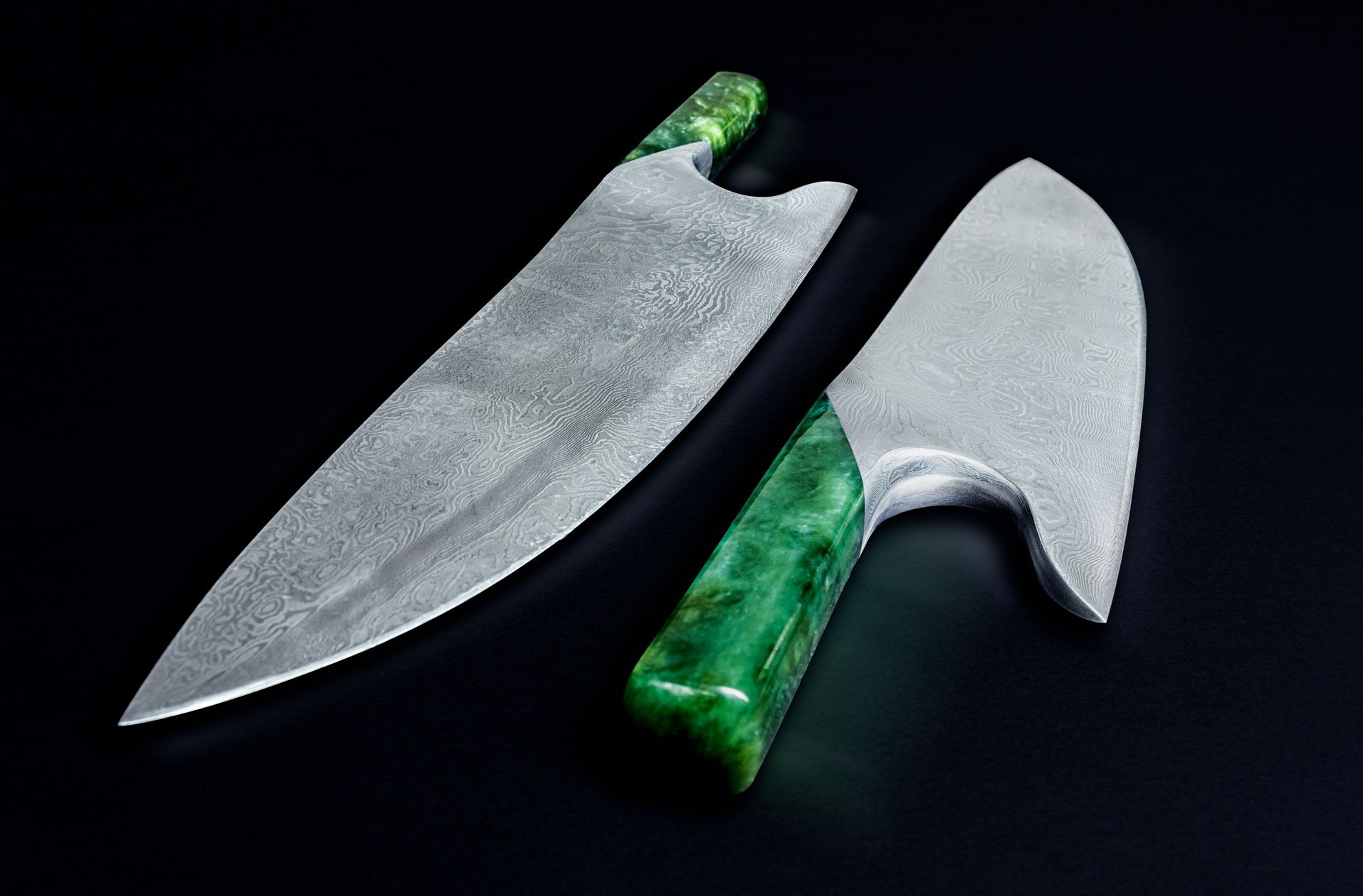
THE KNIFE. JADE Damascus
4.574,00 €
Santoku smooth / Kulle Alpha
Price range: € 126.00 to € 154.00Select version This product has several variants. The options can be selected on the product page

Santoku Kulle walnut
197,00 €
Santoku Kulle barrel oak
197,00 €
Santoku Kulle Alpha Pear
197,00 €
Santoku Smooth / Kulle Olive
Price range: € 162.00 to € 185.00Select version This product has several variants. The options can be selected on the product page

Santoku Damascus
2.329,00 €
Santoku Caminada
Price range: € 195.00 to € 341.00Select version This product has several variants. The options can be selected on the product page

Chai Dao Alpha
150,00 €
Chai Dao walnut
193,00 €
Chai Dao Olive
186,00 €
Chai Dao barrel oak
193,00 €
Chai Dao Damascus
2.402,00 €
Chai Dao pear
193,00 €
Chef's knife Chinaform Damascus
2.400,00 €
Chef's knife Chinaform Alpha
165,00 €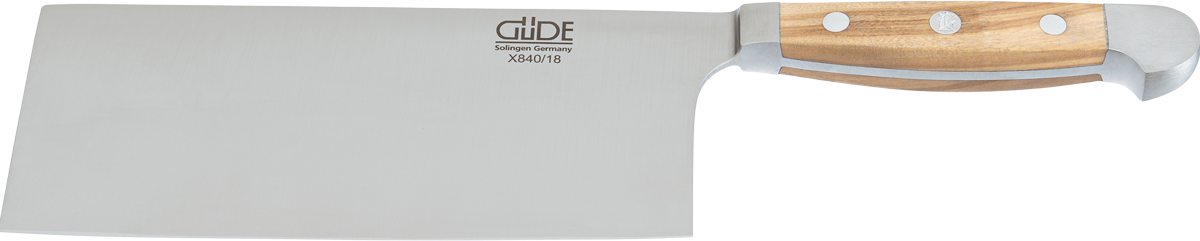
Chef's knife China shape olive
199,00 €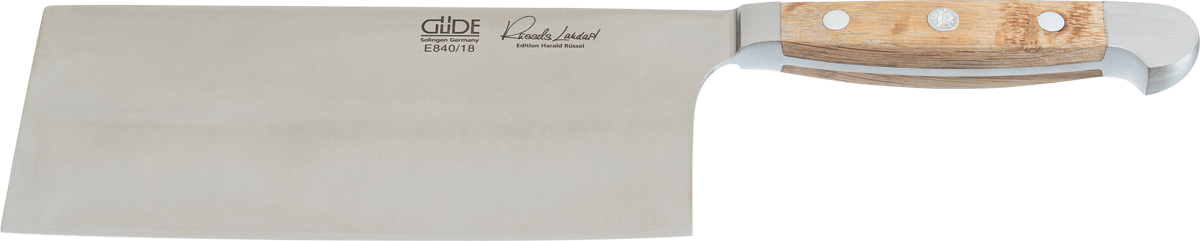
Chef's knife China shape barrel oak
214,00 €
Chef's knife China shape pear
214,00 €Güde – Hand-forged precision from Solingen 1910
The chef's knife is the heart of every kitchen. It cuts, chops, minces, and slices—from morning vegetables to evening roasts. At Güde Solingen , chef's knivesSolingen manufactured for four generations in the same way as founder Karl Güde : forged from a single piece of steel, ground by hand, and fitted with a handle that fits perfectly in the hand.
Whether it's a classic chef's knife, Japanese santoku, or Asian chai dao—every blade shape has its strengths. On this page, you'll learn everything you need to know to find the right Güde for your kitchen.
Hand-forged in Solingen: Every Güde undergoes up to 55 manual steps – from forging the blade to the final honing. The blades, made of chrome-vanadium-molybdenum steel, are ice-hardened to 57–58 HRC, achieving the perfect balance of hardness, flexibility, and edge retention.
Why choose a Güde ?
At a time when most knives are manufactured by machine in Asia, Güde is Güde of the last manufacturers to Solingen its knives without compromise in Solingen . You can feel the difference with every cut:
Drop-forged from a single piece
Unlike stamped knives, Güde are formed from a single piece of steel using traditional drop-forging techniques. The entire blank—from the tip of the blade to the end of the handle—is heated and shaped under high pressure. The result is a homogeneous material structure with no weak points and the characteristic double bolster, which serves as finger protection and ensures perfect balance.
Long-lasting sharpness
The blades are made of chrome-vanadium-molybdenum steel (X50CrMoV15) and are ice-hardened—a process in which the steel is shock-cooled in an ice bath. The resulting hardness of 57–58 HRC means that the blade is hard enough to stay sharp for a long time, but not so hard that it becomes brittle or difficult to resharpen.
Masterful balance
A good chef's knife must be well balanced. With Güde , the center of gravity Güde precisely at the transition between the blade and the handle—where your hand guides the knife. This allows you to work without fatigue, even over long periods of time, and to make precise cuts without exerting force.
More about manufacturing in Solingen
Franz Güde was Güde in 1910 by master grinder Karl Güde . His son Franz took over the company and developed the legendary Güde for bread knives in 1941. Today, the fourth generation runs the factory and adheres to the principles that made Güde : small quantities, handcrafted production, uncompromising quality. Every knife that leaves the factory bears the signature of experienced knife makers.
Buying a chef's knife: Which blade shape is right for you?
Not all chef's knives are the same. The shape of the blade determines which tasks the knife is best suited for. Güde five different types of chef's knives – each with its own strengths and history.
The classic chef's knife
The all-rounder in every kitchen. The curved blade allows for the classic rocking motion: the tip of the blade remains on the board while the handle is moved up and down. Ideal for herbs, onions, and anything that needs to be finely chopped. The wide center of the blade allows you to cut meat, fish, and vegetables—the classic chef's knife can handle any task.
Strengths
- Universally applicable
- Perfect for weighing cuts
- Large blade surface
- Ideal for beginners
Blade lengths
- 16 cm – compact, maneuverable
- 21 cm – the standard
- 26 cm – for large quantities
THE KNIFE The statement knife
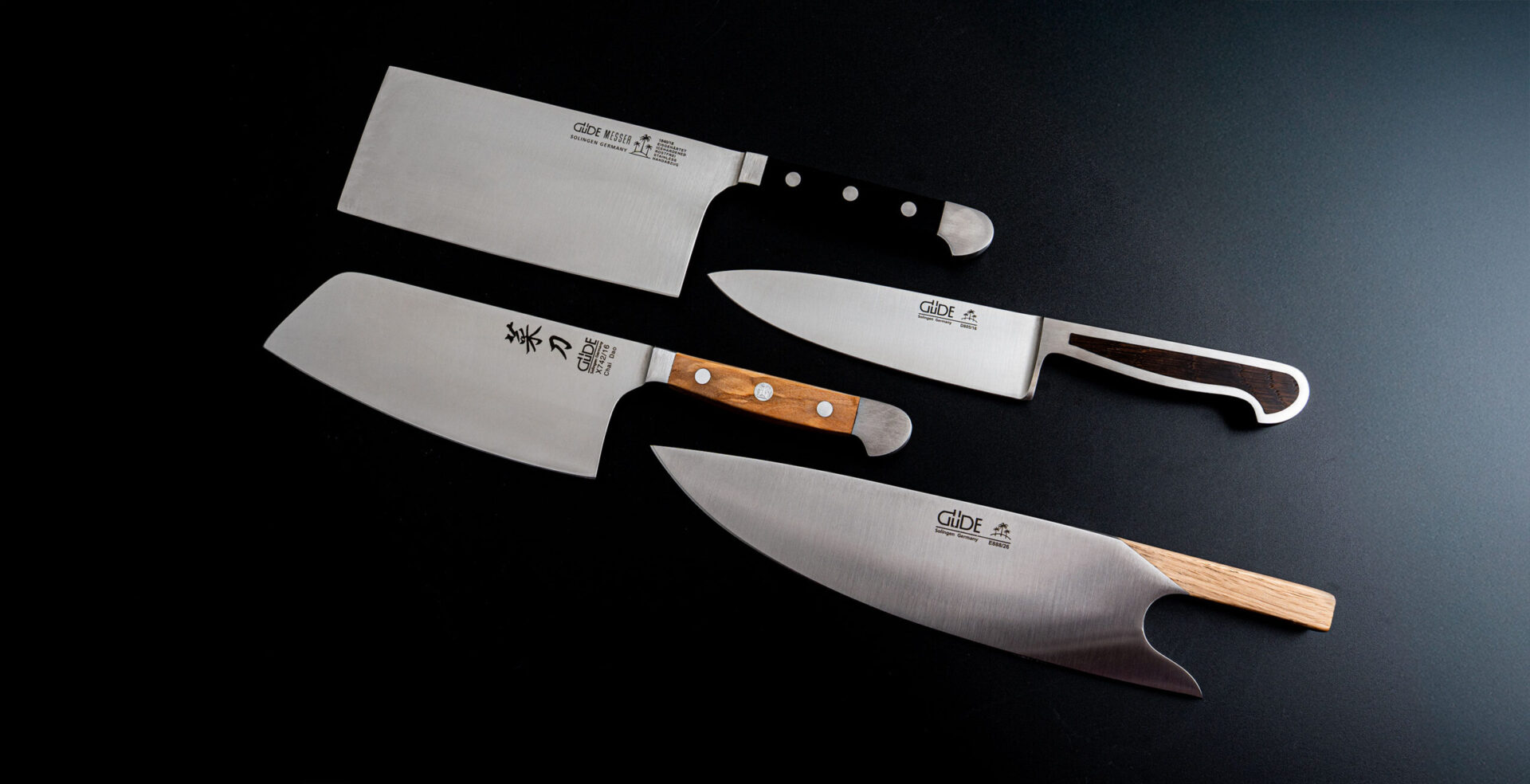
THE KNIFE no ordinary chef's knife. It is an uncompromising statement: modern design, the highest manufacturing quality, and a blade that redefines all standards. Unlike traditional chef's knives, THE KNIFE is THE KNIFE guided by the handle, but with an overhand grip—similar to the Asian cutting technique. The tall blade offers plenty of space for the knuckles, and the sweeping handle fits securely in the hand.
THE KNIFE at experienced chefs who are ready to learn a new cutting technique. Investing in this knife is also an investment in a new cooking experience. Those who take the plunge will be rewarded with a tool that is second to none.
Santoku – The Japanese classic
The Santoku (Japanese for "three virtues") is optimized for three tasks: cutting, chopping, and mincing meat, fish, and vegetables. The shorter, wider blade with its characteristic sheep's nose profile lies flatter on the cutting board than a classic chef's knife. This makes the Santoku ideal for precise, vertical cuts.
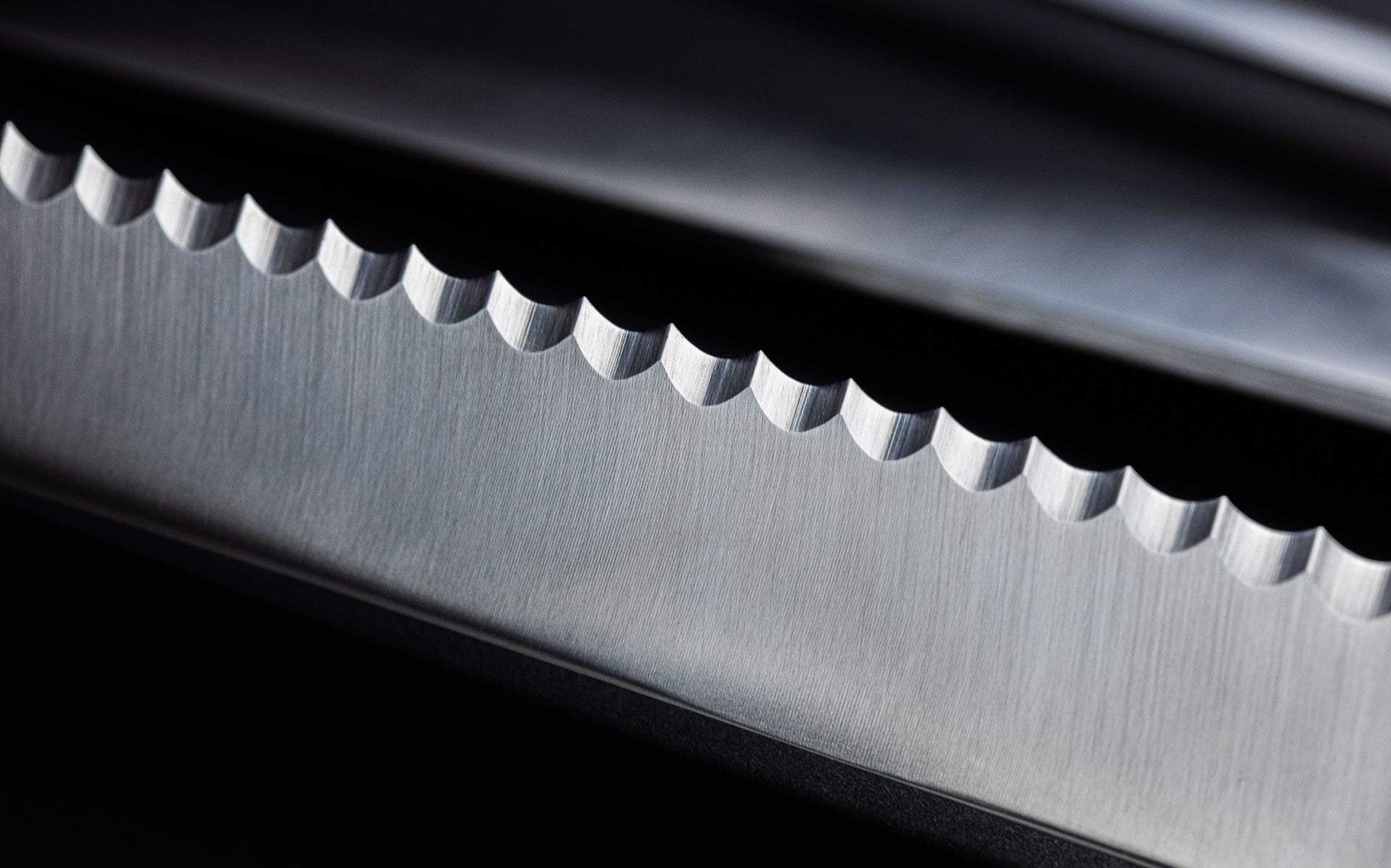
At Güde , the Santoku Güde available with or without a hollow edge. The oval indentations (hollows) in the blade reduce the adhesion of cut food – particularly practical for moist vegetables or thin slices of fish.
Chai Dao – Asian elegance
The Chai Dao (also: Cai Dao) is the traditional vegetable knife used in Chinese cuisine. The rectangular, tall blade is reminiscent of a cleaver, but is significantly lighter and thinner. The Chai Dao is ideal for precise cutting and fine chopping of vegetables and herbs. The flat blade also serves as a scoop for transferring the chopped ingredients from the cutting board to the pan.
Chinese Chef's Knife
The Chinese chef's knife – often referred to as a "Chinese cleaver" – is the all-rounder of Asian cuisine. With its wide, extremely sharp blade, it can handle practically any task, from fine julienne cuts to cutting up poultry. Unlike a real cleaver, the blade is thin and precisely ground. At Güde , the Chinese chef's knife Güde hand-forged and fitted with elegant handles.
Classic
Weighing cut, all-rounder, European tradition
Santoku
Vertical cuts, Japanese precision
Chai Dao
Vegetables, Chinese technique, high blade
Güde : series overview
Güde chef's knives in various series—all with the same high-quality blade, but different handle materials and designs. The choice depends on your preferences, the area of application, and your budget.
Alpha: The classic
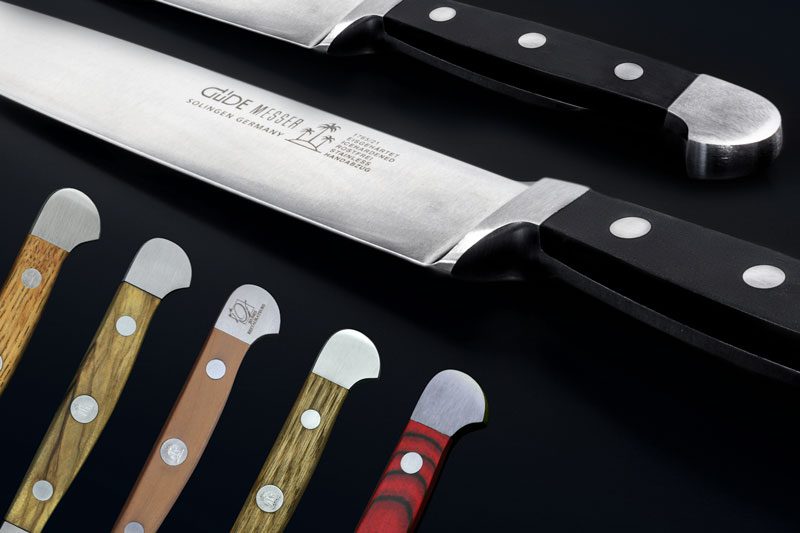
The Alpha is the backbone of the Güde and offers the widest variety of models. The handle, made of robust Hostaform plastic, is easy to clean, dishwasher-safe, and meets the strict hygiene requirements of the catering industry. The characteristic double bolster and palm rivet are trademarks of the series.
Alpha wooden handles
The Alpha is also available with various elegant wooden handles, each with its own character:
Kappa: All metal
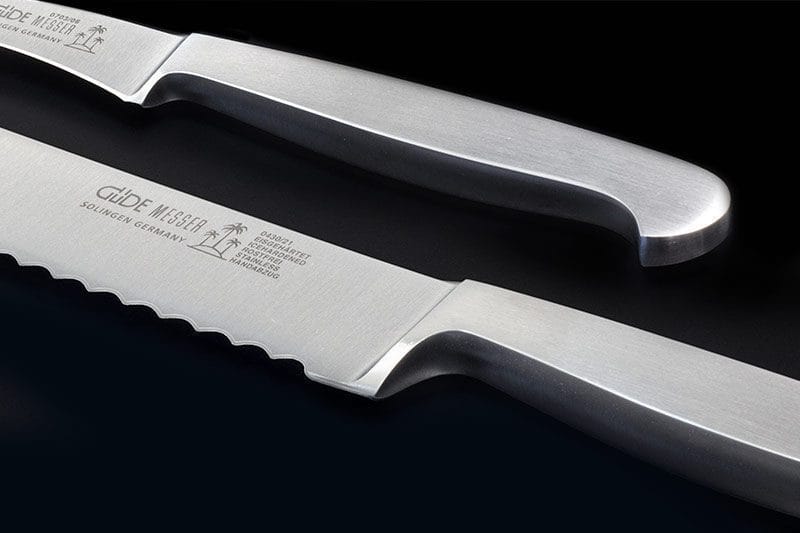
The Kappa is for purists: the entire knife—blade and handle—is made from a single piece of chrome-vanadium-molybdenum steel. No material transitions, no joints, no rivets. The distinctive double bolster serves as finger protection, and the weight is perfectly distributed. Kappa are rustproof, scratch-resistant, dishwasher-safe, and designed for daily use in professional kitchens.
Delta series
The Delta combines classic craftsmanship with modern design. The chef's knives feature handles made from African grenadilla wood—one of the hardest woods in the world, traditionally used in instrument making.
Synchros series
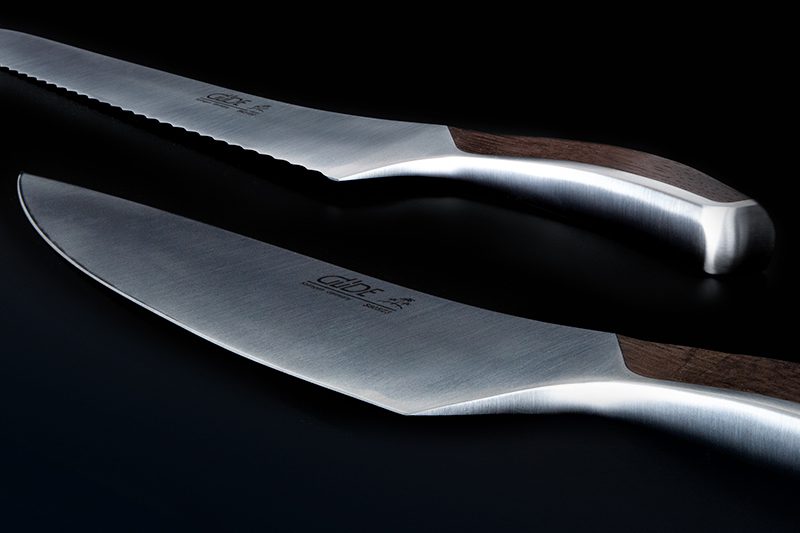
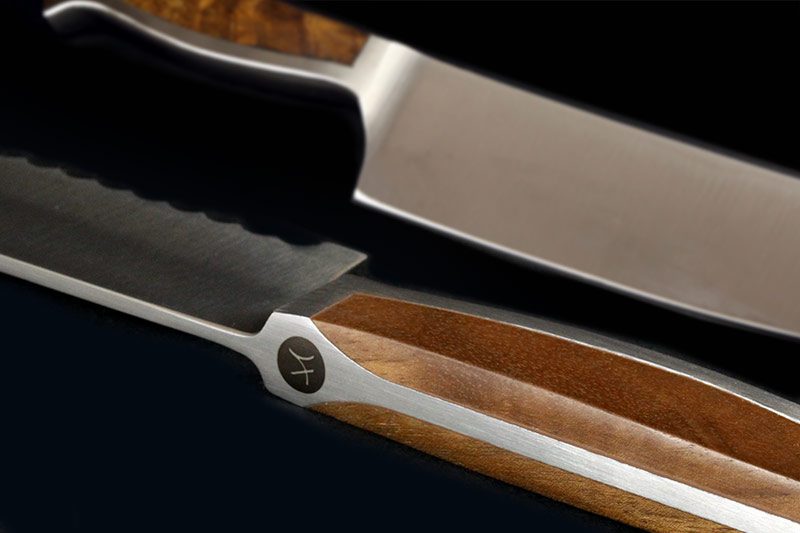
The Synchros marks a new chapter in Solingen's blacksmithing tradition. The handle and blade merge into a harmonious whole thanks to a smooth transition. The continuous, low-set tang ensures perfect balance, while the solid convex handles made of smoked oak have a uniform length of 12.5 cm. The Synchros honored with the Red Dot Design Award.
Franz Güde Karl Güde
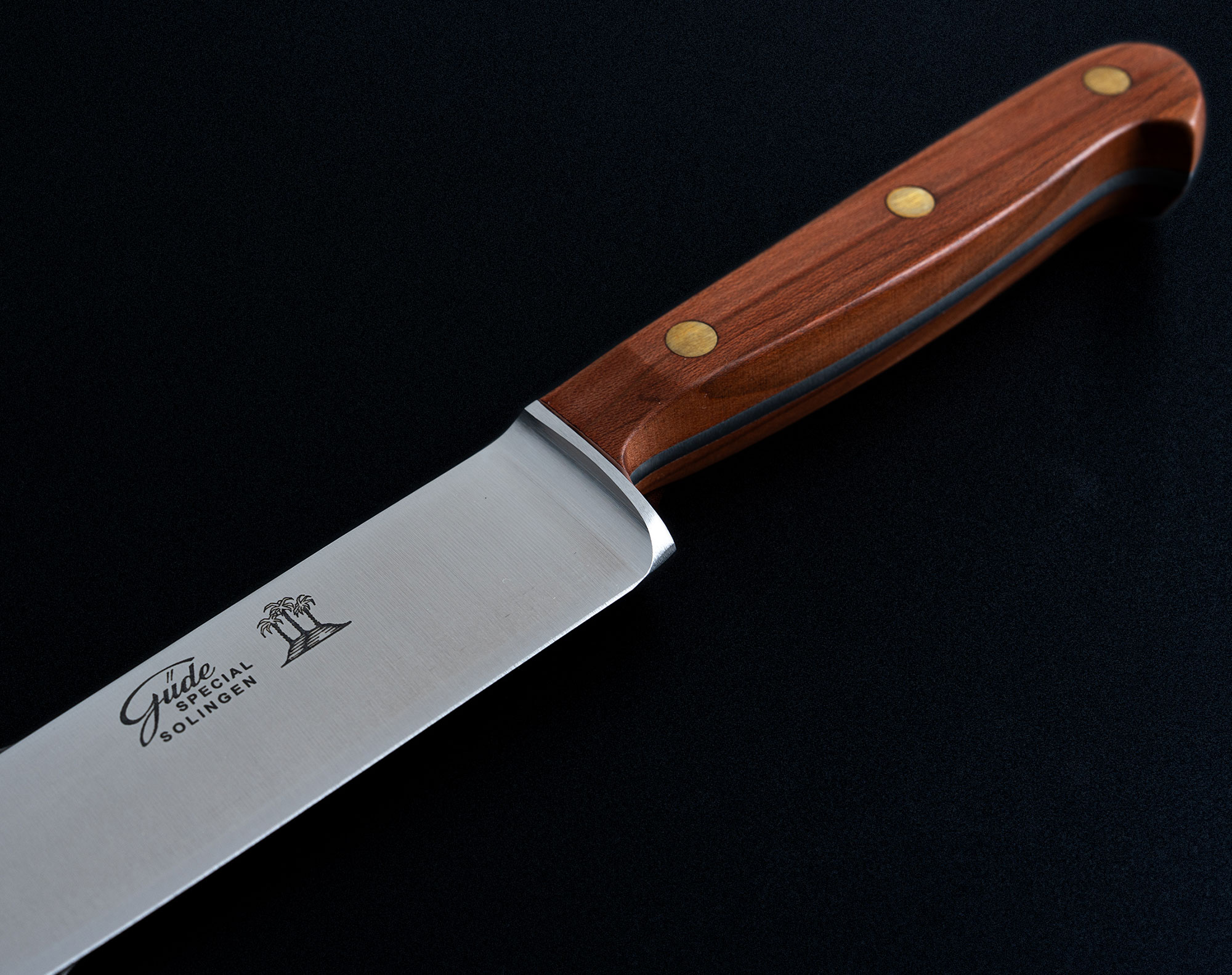
The Franz Güde Karl Güde series Güde homage to the founding generation. The knives show what classic Güde looked like in the 1930s. The Karl Güde has cherry wood handles, while the Franz Güde has plum wood handles—both traditional handle woods used by Solingen knife makers.
Briccole di Venezia
A special edition: the handles are made from original Venetian gondola posts (briccole). This oak wood has stood in the Venice lagoon for centuries and has been transformed into a unique material by the salty environment. Each knife in this series is unique and has its own history.
Damask series
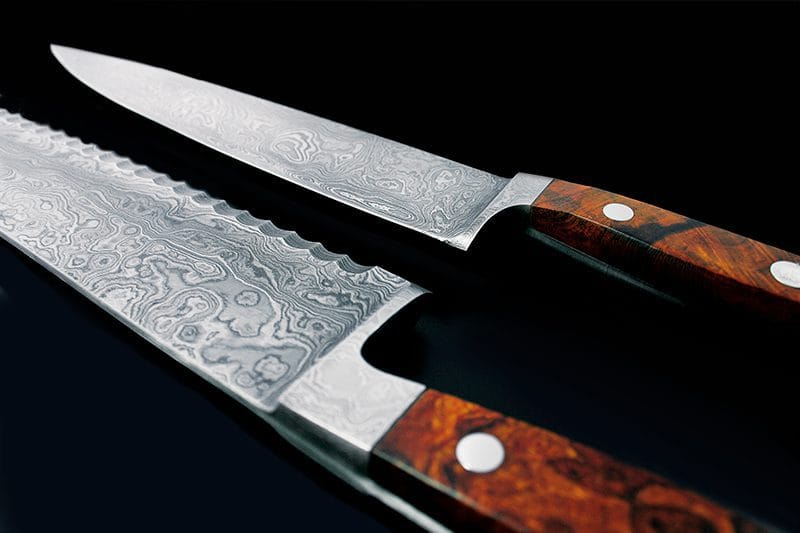
The Güde made of hand-forged Damascus steel is the cream of the crop. Over 300 layers of two different grades of steel are forged into a blade of the highest perfection in a process that takes up to two days. The handle is made of partially petrified desert ironwood, which is up to 1,500 years old. This extremely hard wood has an unusual grain, making each Damascus chef's knife a unique collector's item.
Choosing the right blade length
Güde are available with blade lengths ranging from 16 to 26 cm. The choice depends on your hands, your cutting style, and the intended use.
16 cm – Compact
- Ideal for smaller hands
- Agile and precise
- Good for small kitchens
- Perfect as a second knife
21 cm – The standard
- The all-rounder
- Fits most hands
- Balanced ratio
- Recommendation for beginners
26 cm – For professionals
- Process large quantities faster
- More leverage
- For experienced cooks
- Ideal for large cut surfaces
rule of thumb
- The blade should be 1.5 times as long as the width of your palm.
- When in doubt, go a little larger
- Professional chefs prefer 21–26 cm
If you have only worked with short knives up to now, a 21 cm chef's knife will feel unfamiliar at first. Give yourself time – after a week, you won't want to miss out on the advantages of the longer blade: fewer cutting movements, more control, less fatigue.
Comparison of handle materials
The handle determines the feel, care, and appearance of your chef's knife. Güde a variety of materials, each with its own strengths.
Hostaform plastic (Alpha)
The classic choice for professional kitchens: easy to clean, dishwasher safe, hygienic. Hostaform is a high-quality technical plastic that retains its shape even with intensive use. The black, finely polished surface is timelessly elegant and non-slip.
All metal (Kappa)
For purists: the entire knife is made from a single piece of stainless steel, with no material transitions. Particularly hygienic, extremely robust, dishwasher-safe. The metal handle feels cool and offers a different feel to wood or plastic.
olive wood
Warm, vibrant, unique: each olive wood handle is one of a kind thanks to its grain. The wood used is 300–500 years old and comes from selected olive trees. Olive wood is hard, oily, and therefore naturally resistant. Not dishwasher safe—hand wash only.
barrel oak
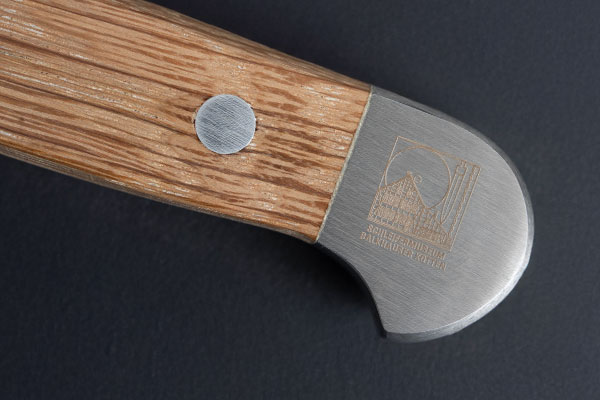
History in your hands: the handle scales are made from oak wood sourced from wine barrels that are over 80 years old. Long maturation in contact with wine has made the wood virtually indestructible. The dark color and distinctive grain make each knife unique.
micarta
Technology meets tradition: Micarta consists of layered cotton bonded with epoxy resin. The result is a material that is as robust as plastic but offers the warmth and feel of wood. The subtle tone-on-tone grain gives Güde Micarta knives an exquisite look.
Care, cleaning, and storage
A Güde is made to last for generations—provided you treat it properly. The most important rules:
cleaning
After use, the chef's knife should be cleaned immediately with a damp cloth and dried thoroughly. Never leave the knife uncleaned—acids from food (lemon, tomato) can attack even stainless steel. Do not use corrosive or abrasive cleaning agents.
Dishwasher – yes or no? The Alpha with plastic handles and the Kappa in solid metal are dishwasher safe. However, for maximum durability, we recommend hand washing: the aggressive cleaning additives and high temperatures in the dishwasher can impair the sharpness of the blade. Chef's knives with wooden handles should never be put in the dishwasher.
storage
The best place for your chef's knife is a knife block or magnetic strip. Both protect the blade from damage and keep the knife handy. Güde knife blocks in various designs to match all series.
Avoid storing them in the cutlery drawer: the blades will knock against each other or other cutlery, causing nicks and dulling. If you have no other option, use blade guards or drawer inserts.
Care of wooden handles
Wooden handles should be treated regularly with wood oil. The oil is absorbed into the wood, nourishing it and protecting it from drying out. This will keep your olive wood, barrel oak, or walnut handle looking beautiful and providing a good grip for years to come.
1. Clean immediately: Rinse and dry after use—don't leave it lying around.
2. Store properly: In a knife block or on a magnetic strip—not loose in a drawer.
3. Cut properly: Only on wooden or plastic boards—never on glass, stone, or metal.
Sharpening and honing: How to keep your chef's knife sharp
With every cut, a knife loses a little bit of its sharpness. This is normal and not a sign of poor quality. The question is: how do you keep your Güde sharp in the long term?
Sharpening steel – for everyday use
The sharpening steel straightens the cutting edge, which bends microscopically during cutting. Regular sharpening—ideally before each use—keeps the blade in shape and significantly extends the intervals between actual sharpening. Güde sharpening steels in various designs, tailored to its own knife series.
Whetstone – for genuine re-sharpening
If the sharpening steel no longer helps, the blade must be reground. Grinding and honing stones are among the oldest methods of sharpening knives—and among the best. With a little practice, you can sharpen your chef's knife yourself while maintaining the original grind.
Güde service
If you want to be on the safe side, use our sharpening service. Your knife will be resharpened in Solingen the original tools—often by the same knife makers who originally manufactured it. This will restore your chef's knife to its original sharpness.
Frequently asked questions about Güde
That depends on your needs. For professional kitchens, we recommend Alpha a plastic handle or Kappa all-metal. For connoisseurs, the wooden handle versions are the first choice. THE KNIFE for experienced cooks who want to learn a new cutting technique. As an all-rounder, a classic chef's knife with a 21 cm blade is the best choice for beginners.
The classic chef's knife has a curved blade that is optimized for rocking cuts—the tip remains on the board while the handle moves up and down. The Santoku has a flatter blade with a sheep's nose profile, ideal for vertical cuts. Both knives are all-rounders, but with different strengths.
The Alpha with plastic handles and the Kappa are dishwasher safe. However, for maximum durability, we recommend hand washing. Chef's knives with wooden handles (olive, barrel oak, walnut, pear) should never be placed in the dishwasher, as the wood can swell and crack.
That depends on how often you use it. For normal household use, genuine resharpening is sufficient every 6–12 months. More important is regular sharpening with a sharpening steel—ideally before each use. This keeps the cutting edge in shape and significantly extends the sharpening intervals.
16 cm for smaller hands or as a handy second knife, 21 cm as standard and recommended for beginners, 26 cm for experienced cooks and large quantities. As a rule of thumb, the blade should be about 1.5 times as long as the width of your palm.
During ice hardening, the heated steel is shock-cooled in an ice bath. This process refines the crystal structure of the steel and increases its hardness to 57–58 HRC. The result: the blade stays sharp longer, but is not so hard that it becomes brittle or difficult to resharpen.
The double bolster is the trademark feature of drop-forged Güde . It consists of two thickened sections of steel at the transition between the blade and the handle. The front bolster serves as a finger guard and prevents the hand from slipping onto the blade. The rear bolster ensures perfect balance and fits comfortably in the hand.
Yes. The Alpha meets all hygiene requirements for the catering industry. The Kappa is designed for intensive continuous use in professional kitchens. Güde are popular with amateur and professional chefs alike—their long-lasting sharpness, masterful balance, and robust workmanship make them reliable tools for any task.
Prices vary depending on the series and blade length. An Alpha with a 21 cm blade starts in the mid-price range, with wooden handle versions priced higher. Damascus chef's knives with desert ironwood handles are exclusive collector's items in a price category of their own. Every Güde is an investment in quality that will pay off for decades.
All Güde are Solingen in Solingen —since 1910, now in the fourth generation. Each chef's knife undergoes up to 55 manual steps in the factory: from forging the blade to grinding it and assembling the handle. At Güde , "Made in Solingen Güde a marketing slogan, but a living tradition.
Buy Güde : Quality that lasts
A good chef's knife is an investment—in your kitchen, in your cooking experience, in a tool that you use every day. Güde have been manufactured according to the same principles for over 100 years: forged from a single piece of steel, ground by hand, fitted with a handle, and sharpened by hand.
The blades are made of chrome-vanadium-molybdenum steel, are rustproof, ice-hardened, and retain their sharpness for a long time. The handles—whether plastic, metal, or fine wood—fit perfectly in the hand. The balance is adjusted so that you can work without fatigue, even when cutting large quantities.
Discover the variety of Güde : from classic all-rounders to Japanese Santoku knives to the uncompromising THE KNIFE. Find the knife that suits your cutting style—and experience what pure cutting pleasure means.